
Missed deadlines don’t come out of nowhere. Often, they’re the predictable result of resourcing issues that could have been visible weeks earlier, if the right information was in place.
When resource planning fails, the consequences can be far-reaching. Projects slip, staff burn out, and clients lose confidence. By the time the problem surfaces, the window to fix it has usually closed.
For A&E firms managing multiple concurrent projects across different phases, effective resource planning isn’t a nice-to-have. It’s the foundation of reliable project delivery.
What Is Resource Planning in Project-Based Firms?
Resource planning is the process of matching the right people to the right work at the right time.
In an A&E firm, this means knowing which team members are available, what skills each project requires, and how capacity is distributed across the portfolio. Not just this week, but across the coming months. It means being able to see, at a glance, where you have gaps and where you’re over-committed.
The 2026 Architecture Industry Benchmark Report recently found that 56% of architecture firms still manage resources manually, using spreadsheets or internal meetings. But without clear visibility, decisions become reactive, and problems are often discovered too late to fix.
Strong resource planning supports consistent delivery, protects staff wellbeing, and keeps projects on schedule and on budget. Without it, resourcing becomes one of the most reliable predictors of project underperformance.
How Misaligned Resources Delay Project Timelines
A project delivery timeline is only as reliable as the resource plan behind it.
Picture this: a key team member goes on leave, but nobody realises it creates a gap on a project until the week it happens. Or the people allocated to a project phase are already committed elsewhere, so milestones slip. Meanwhile, some staff are stretched thin while others have extra capacity.
This is the day-to-day reality for A&E firms without structured resource planning. In an environment where teams work across multiple jobs, a single resourcing gap can trigger a chain reaction across the portfolio.
Why Overbooking and Underutilisation Hurt Performance
Overbooking and underutilisation are two sides of the same problem: no clear picture of where your people actually are.
When people are overbooked, work gets rushed. Quality drops, stress rises, and burnout becomes a real risk. Over time, this affects both team performance and client relationships. Underutilisation means you’re paying for capacity that isn’t contributing to revenue, compressing margins without any visible warning.
Both are common in firms that rely on informal resource planning for project delivery. Decisions are made quickly without checking real availability. Someone appears free, so they get assigned, without checking what they’re already committed to. That’s how conflicts develop and how good people end up carrying too much or too little.
A structured approach replaces that guesswork with clarity. Project managers can see real availability and make decisions that hold up over time.
What Data Is Needed for Effective Resource Planning
Good resource planning depends on having the right information, connected in one place.
That means visibility into project pipelines and confirmed workloads at the same time. It means tracking time accurately so capacity decisions are based on real data, not estimates.
Firms also need to look beyond the current week. Planning across the next quarter gives leaders the ability to anticipate demand, identify gaps, and make informed decisions before pressure builds in the middle of project delivery.
When this data is accessible in real time, resource planning shifts from reactive to proactive. Leaders can spot capacity gaps before they become project delivery problems and adjust resourcing before milestones are at risk.
How Strategic Planning Improves Project Delivery
The difference between a firm that consistently delivers on time and one that doesn’t often comes down to how far ahead a firm plans.
A&E firms with strong resource visibility can assess the impact of a new project before it’s confirmed. They can understand whether the team has capacity, where pressure points may arise, and how to sequence projects effectively.
That kind of strategic planning doesn’t need to be complicated. It simply requires the right information, structured so it’s easy to act on quickly.
How Total Synergy Optimises Resource Planning Across Projects
Resource planning is not just an operational task. It is a critical part of delivering projects successfully.
Built in Australia with support teams in Sydney and London, Total Synergy brings resource planning, time tracking, and project delivery together in one platform, built specifically for A&E firms.
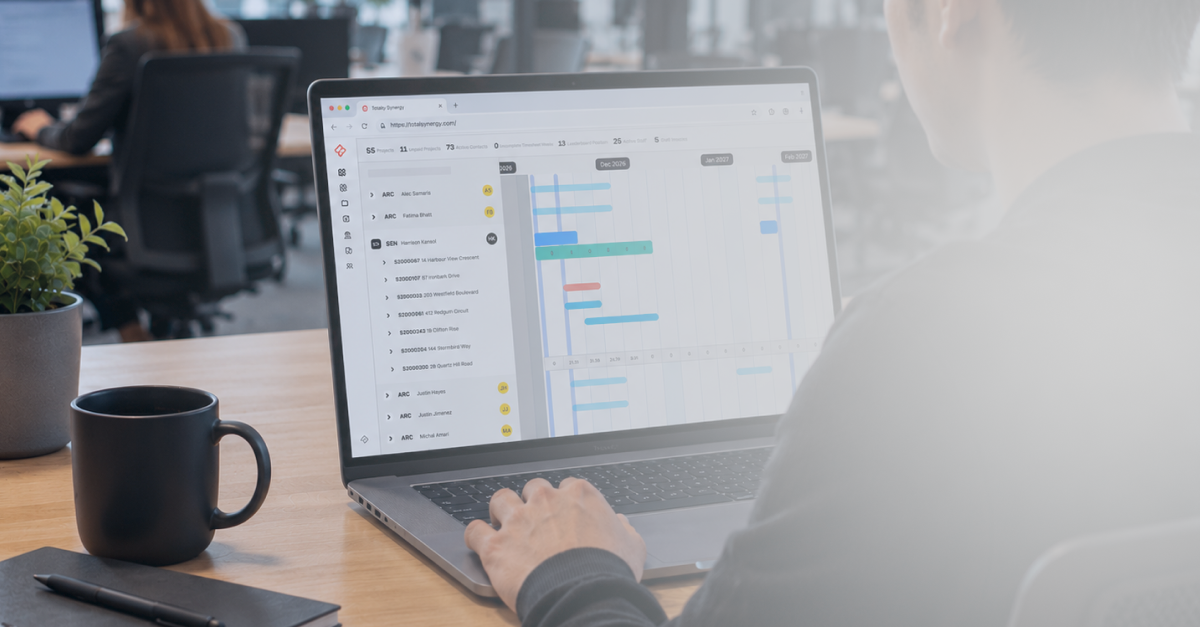
Project managers get a real-time view of team availability, workload distribution, and capacity across the portfolio. Dynamic scheduling lets you adjust assignments and timelines, and see the downstream impact straight away. Timesheets sync automatically against project budgets, so the data behind your resourcing decisions is always current.
Instead of reacting to delivery problems after they occur, your team can intervene early, rebalance where needed, and keep projects on track.
Book a demo with our team today to see how Total Synergy’s resource planning tools can help your firm deliver more projects, on time and within budget.