Referrals have always been the lifeblood of architecture practices, and 2026 is no different.
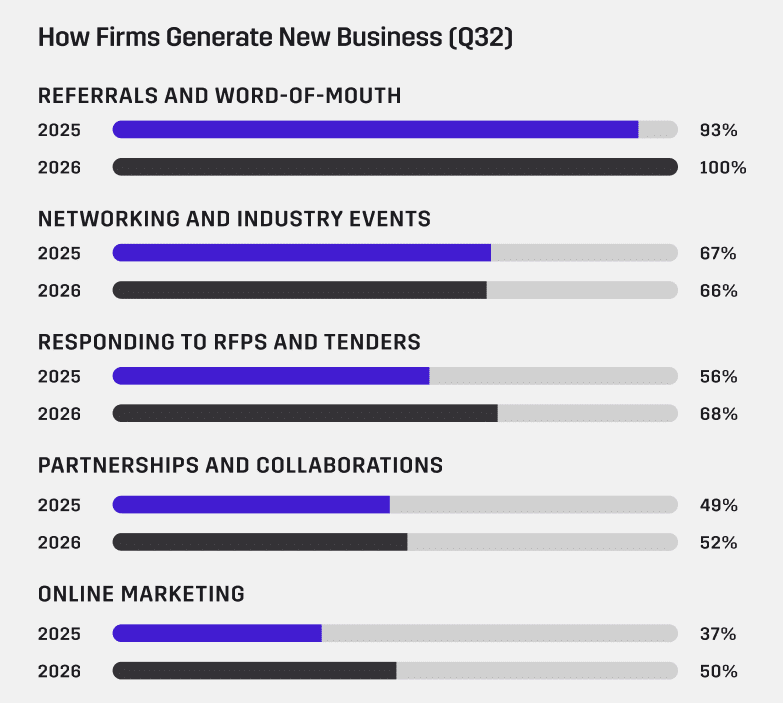
According to the 2026 Architecture Industry Benchmark Report, 100% of firms identify word-of-mouth and referrals as a source of new business. That’s a figure that hasn’t meaningfully changed in years.
What has changed is the competitive context in which those referrals are landing, and how firms are supplementing them.
Practices Are Investing More in Outbound Channels
In a tighter market, firms are leaving less to chance. Responding to RFPs and tenders has grown from 56% to 68% as a business development channel, and online marketing has risen from 37% to 50%. Both shifts point in the same direction: practices that once relied primarily on inbound referrals are now building more structured outbound activity alongside them.
That investment is happening against a backdrop of shrinking marketing budgets. In 2026, 75% of firms allocate less than 3% of revenue to marketing and business development, up from 59% in 2025. Doing more with less is not a new challenge for architecture practices, but the gap between resource and ambition is widening.
Client Relationships Remain the Foundation, But Few Measure Satisfaction Levels
Repeat client rates are stable and healthy. In 2026, 60% of firms report that more than half of their clients return for additional work, reflecting the relationship-driven nature of architectural practice.
However, the way firms measure and manage those relationships is lacking. More than half of firms have no formal method to measure client satisfaction, and only 24% use a dedicated CRM to manage client data and interactions. In a market where consistent, high-quality delivery is the clearest differentiator, client satisfaction could become a vital metric to track.
In terms of maintaining long-term client relationships, high-quality project delivery was cited by 45% of respondents as the most important factor, followed by strong communication and responsiveness at 25%, and personal relationships at 25%. Despite increased fee pressure, only 5% of firms say that competitive pricing plays a major role in client relationships.
The firms with the strongest business development pipeline tend to treat client delivery and client development as two sides of the same coin. Consistent project delivery and the financial visibility to support it are what keep clients coming back.
How Does Your Firm Compare?
The 2026 Architecture Industry Benchmark Report draws on responses from architecture practices across the globe to give the sector a clear picture of how firms are operating right now, covering opportunities and challenges spanning everything from profitability, staffing, technology and growth.
For more insights, and to discover how your margins, utilisation and business development efforts compare to firms like yours, download the report here to see the full picture.
About Total Synergy (Australia)
Total Synergy is an Australian software company based in North Sydney, NSW, helping architecture and engineering practices across Australia improve project visibility, resourcing, and profitability with project management and practice management software. Try Total Synergy for free today and discover how the platform can transform your firm.