

From fee pressure to pipeline compression, the 2026 Architecture Industry Benchmark Report reveals the forces making practice management harder this year, and what the best-performing firms are doing about it.
Fee Pressure The Defining Challenge For New Business
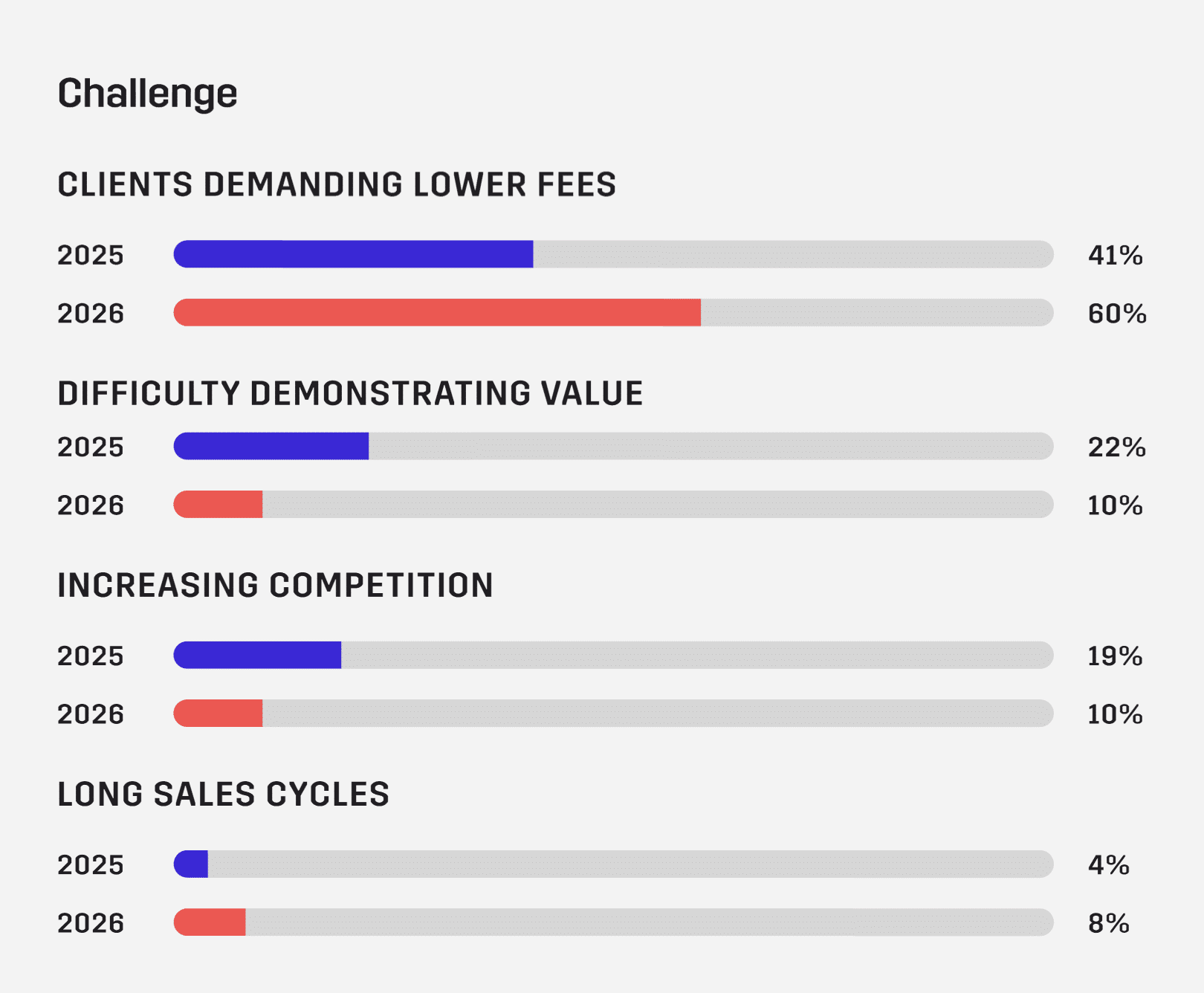
In 2026, 60% of architecture firms identify clients demanding lower fees as their single biggest challenge in winning new work. In 2025, that figure was 41%. That is a sharp increase year-on-year, and it reflects a market where clients are more cost-conscious, more likely to compare options, and less willing to accept a fee without scrutiny.
The firms holding their position most effectively are not necessarily the cheapest. They’re the ones with the strongest delivery track record and the clearest evidence to back it up. High-quality project delivery was cited by 45% of respondents as the most important factor in maintaining long-term client relationships, ahead of pricing by a significant margin.
Defending your fees starts with being able to show clients exactly what they are getting. Consistent project delivery and the financial transparency to support it are what make that case.
Pipeline Compression is Putting Resourcing Under Pressure
With 70% of architecture firms having three months or fewer of secured work in their backlog, a shorter pipeline isn’t just a revenue concern anymore; it makes every resourcing decision harder.
When firms cannot see far enough ahead, the risk of teams being stretched too thin or leaving people without enough work grows with every passing week. Principals end up managing short-term capacity decisions while simultaneously trying to win the next project.
Real-time resource planning gives firms the visibility to make those decisions with confidence, rather than relying on instinct and spreadsheets.
Admin is Consuming Time That Should Go to Design
A third of all architecture firms now report that their teams spend less than half of their working time on actual design work. In 2025, that figure was 19%.
The tasks taking up the time are not optional. Project management, client communication, approvals, time tracking, invoicing, and billing all need to happen. The problem is how they happen. When these tasks are handled manually across disconnected tools, the coordination overhead grows far beyond what it should be.
Utilisation is improving across the sector, but only 25% of firms track it consistently as a firm-wide metric. Every percentage point of untracked utilisation is billable time that quietly disappears. Firms that bring time tracking, project management, and billing into a single platform consistently recover hours they did not know they were losing.
How Does Your Firm Compare?
The 2026 Architecture Industry Benchmark Report draws on responses from architecture practices across the globe to give the sector a clear picture of how firms are operating right now, covering opportunities and challenges spanning everything from profitability, staffing, technology and growth.
For more insights, and to discover how your margins, utilisation and business development efforts compare to firms like yours, download the report here to see the full picture.
About Total Synergy (Australia)
Total Synergy is an Australian software company based in North Sydney, NSW, helping architecture and engineering practices across Australia improve project visibility, resourcing, and profitability with project management and practice management software. Try Total Synergy for free today and discover how the platform can transform your firm.