


In 2025, the biggest concern for firms was finding experienced architects. But according to the 2026 Architecture Industry Benchmark Report, two thirds of firms now say their biggest personnel challenge is managing project demand with their current staff levels, up 16 percentage points from last year.
That shift reflects the broader pipeline compression visible across the sector [link, first blog]. When backlog shrinks and forward visibility shortens, the difficulty is no longer simply hiring enough people. It becomes a more complex problem of matching the people you have to the work that is actually confirmed, without over-committing or leaving capacity unused.
Firms Experiencing Varying Turnover
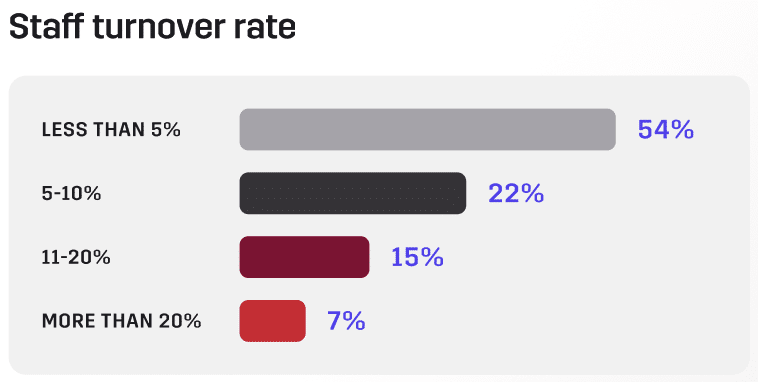
Staff turnover data in 2026 tells two stories at once. On one hand, more firms are experiencing very low turnover, with 54% reporting annual staff turnover below 5%, up from 44% in 2025. On the other hand, a small but growing cohort of practices is seeing turnover above 20%, pointing to structural or cultural challenges that aren’t easy fixes.
Retention strategies remain largely consistent year on year, with work-life balance initiatives and a strong company culture cited by more than 70% of respondents. The most notable shift is in professional development, which has grown from 44% in 2025 to 63% in 2026 as a retention priority. Firms are increasingly treating investment in staff growth as a competitive advantage rather than an optional benefit.
Career Structures Are Maturing, But People Management Tools Lag
In addition to increased investment in staff grow, the 2026 data shows the improvement in structured development pathways across architecture firms. In 2025, nearly half of all firms had no defined development structure for staff. In 2026, that figure has halved to 25%, with 50% of practices now offering informal but consistent pathways and 25% running a formal mentorship or promotion track.
Despite this, more than half of architecture practices still manage their people without a dedicated HR system. As practices grow and compliance requirements tighten, the absence of structured people management creates an increasingly visible operational gap, particularly when navigating workforce planning in an uncertain pipeline environment.
If you want to see how purpose-built tools can support resourcing clarity and capacity planning across your firm, explore how Total Synergy approaches resource allocation.
How Does Your Firm Compare?
The 2026 Architecture Industry Benchmark Report draws on responses from architecture practices across the globe to give the sector a clear picture of how firms are operating right now, covering opportunities and challenges spanning everything from profitability, staffing, technology and growth.
For more insights, and to discover how your margins, utilisation and business development efforts compare to firms like yours, download the report here to see the full picture.
About Total Synergy (Australia)
Total Synergy is an Australian software company based in North Sydney, NSW, helping architecture and engineering practices across Australia improve project visibility, resourcing, and profitability with project management and practice management software. Try Total Synergy for free today and discover how the platform can transform your firm.