

If you ran an architecture firm in 2025 with six months of secured work ahead of you, you probably felt reasonably confident about resourcing. In 2026, that buffer has shrunk for most firms, and the implications go far beyond finding the next project.
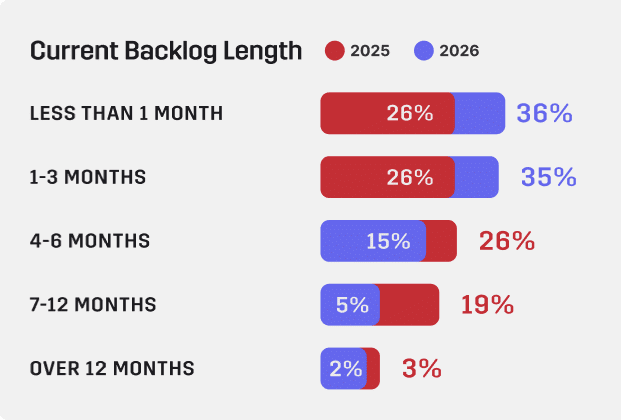
According to the 2026 Architecture Industry Benchmark Report, 70% of firms now have three months or fewer of secured work in their backlog, up from 48% in 2025. More than a third of practices have less than one month confirmed at any given time. That’s a meaningful shift, with the day-to-day implications for firms being significant.
Backlog Compression Creates More Than a Revenue Problem
Backlog is more than a financial metric; it can be the foundation for every resourcing decision a firm makes. When you can see six months ahead, you can hire, plan leave, balance workloads, and take on new projects with confidence. When that window narrows to a matter of weeks, those same decisions become a lot harder to get right.
Only 2% of respondents across the architecture industry had a backlog of over 12 months, with 7% being unsure. For smaller practices without deep reserves, a compressed pipeline creates compounding pressure and an urgency to win new work when principals are already stretched thin. As a result, the risk of over-committing staff or leaving teams without enough work grows every week.
Real-time resource planning becomes critical in this environment. Knowing exactly who is available, when, and at what capacity is what separates a confident staffing decision from an expensive guess.
Hybrid Work is The New Standard
Year-on-year, one thing that has not changed is working models in architecture. Hybrid work remains the dominant model, with 70% of architecture firms operating a blend of remote and in-office arrangements, consistent with 2025. Fully remote practices account for just 3% of the sector.
The flexibility conversation has largely settled, with firms moving on to making hybrid work well, rather than debating whether to adopt it.
The practices managing pipeline compression most effectively tend to share one thing in common: clear, real-time visibility into where their people are, what they are working on, and what is coming next. When forward certainty is limited, operational visibility becomes a genuine competitive advantage.
How Does Your Firm Compare?
The 2026 Architecture Industry Benchmark Report draws on responses from architecture practices across the globe to give the sector a clear picture of how firms are operating right now, covering opportunities and challenges spanning everything from profitability, staffing, technology and growth.
For more insights, and to discover how your margins, utilisation and business development efforts compare to firms like yours, download the report here to see the full picture.
About Total Synergy (Australia)
Total Synergy is an Australian software company based in North Sydney, NSW, helping architecture and engineering practices across Australia improve project visibility, resourcing, and profitability with project management and practice management software. Try Total Synergy for free today and discover how the platform can transform your firm.