


Matching the right person to the right project shouldn’t require a spreadsheet and multiple phone calls. But for many engineering firms, that’s (unfortunately) exactly what resource allocation looks like: a manual process driven by memory, availability guesswork, and whoever shouts loudest for a team member.
Good resource allocation tools give you a clear, real-time view of who is available, who is overloaded, and how your team’s time is being spent across your project portfolio. Here are 5 worth considering.
Why Resource Allocation Matters More Than Firms Realise
Staffing costs are the single largest expense for most engineering practices. How you allocate that resource across projects determines not just delivery outcomes, but project profitability.
Over-allocate a senior engineer on a fixed-fee project and you erode the margin. Leave a mid-level team member under-utilised for two weeks and you’re paying for capacity that can’t be recovered. Allocate the wrong skill set to a project phase and you create rework that was never in the budget.
The best resource allocation tools for engineering firms connect availability, skill sets, and project demand in a way that supports better decisions, faster.
Top 5 Resource Allocation Tools For Engineering Firms
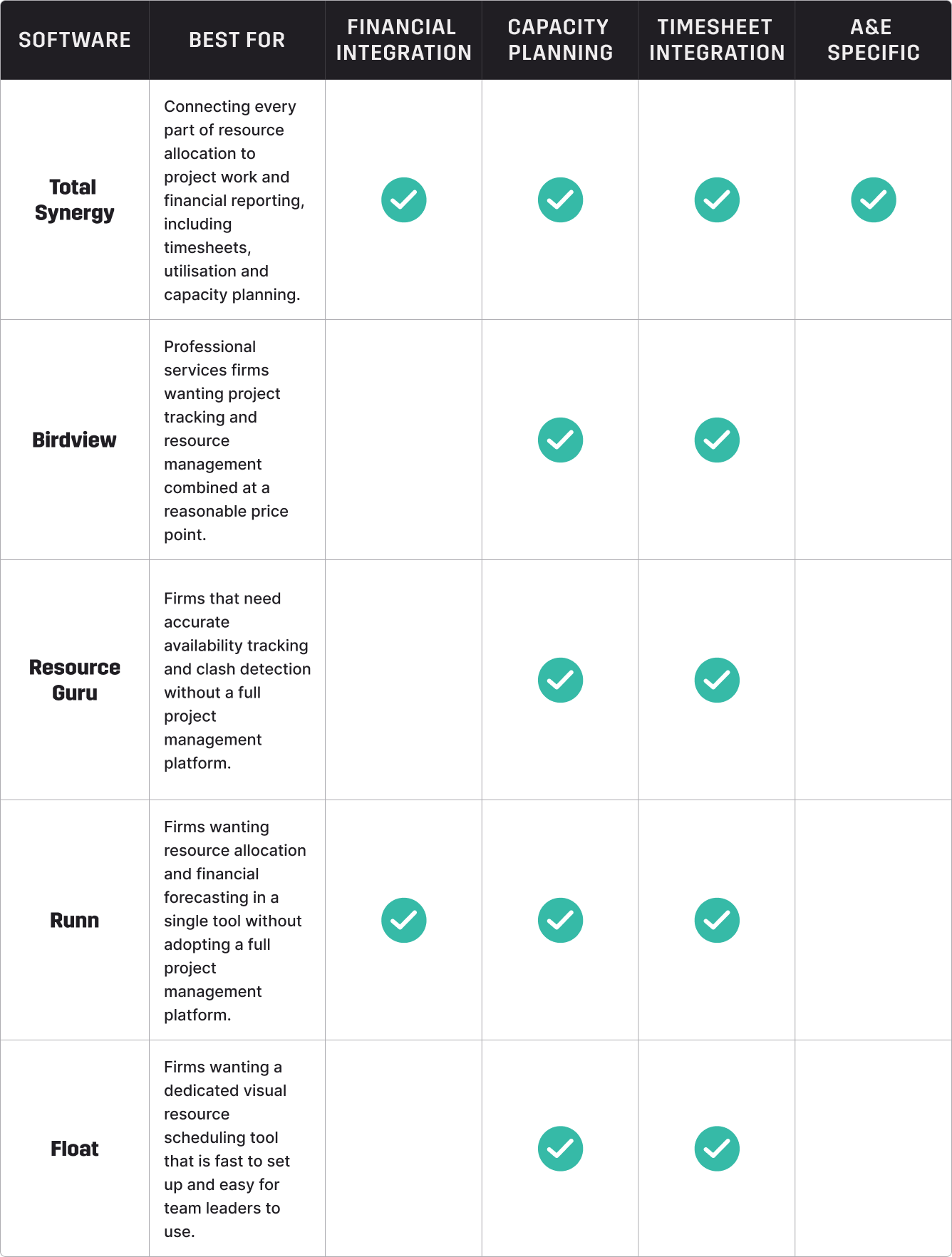
1. Total Synergy
Total Synergy is a practice and project management tool purpose-built for architects and engineers. Resourcing sits inside the same all-in-one platform as project budgets, timesheets, and financial reporting. This is what separates it from standalone resourcing tools: allocation decisions are made with full financial context.
Key features include:
Visual resource scheduling: See your full team’s allocations across projects in a clear, visual format. View by week or month, by individual or team, and across the entire project portfolio.
Availability and capacity management: Total Synergy shows you who has capacity and who is at or over their allocation, before you commit to a new project or take on additional work.
Conflict detection: When a staff member is double-booked or over-allocated, the platform flags it so you can resolve conflicts proactively rather than discovering them mid-delivery.
Budget-connected allocations: Allocations are linked to project budgets and phase hours, so you can see whether a planned allocation fits within the financial parameters of the project before assigning it.
Timesheet reconciliation: Planned allocations are compared to actual time logged, giving managers a clear picture of where estimates were accurate and where future planning needs to be adjusted.
Utilisation dashboards: Monitor billable utilisation rates across the team and by individual. Identify patterns across projects and periods to improve future allocation decisions.
2. Birdview
Birdview is a project and resource management platform designed for professional services firms, covering capacity planning, resource scheduling, project tracking, and reporting in a single interface.
For engineering firms, Birdview is a capable option for teams that want resource planning integrated with project oversight. Its financial management depth is limited for A&E-specific needs, but it is a more integrated option than standalone scheduling tools.
Best for: Professional services firms wanting project tracking and resource management combined at a reasonable price point.
3. Resource Guru
Resource Guru is a resource scheduling platform with a strong availability management interface and clash detection built in.
For engineering firms, Resource Guru is a reliable and straightforward option for managing allocations, but operates as a scheduling layer without connecting to project budgets or financial outcomes.
Best for: Firms that need accurate availability tracking and clash detection without a full project management platform.
4. Runn
Runn combines resource planning with project revenue forecasting. Allocations in Runn connect to project revenue data, so managers can see the financial impact of their resourcing decisions as they make them.
For engineering firms, Runn isn’t purpose-built for A&E and lacks phase-level project management, but it is a stronger option for firms that want resource allocation and financial forecasting connected.
Best for: Firms wanting resource allocation and financial forecasting in a single tool without adopting a full project management platform.
5. Float
Float is one of the most widely adopted dedicated resource scheduling tools for professional services teams. Its visual drag-and-drop interface makes it easy to see who is available, assign work across projects, and adjust allocations as project needs change.
Float operates independently of project financial data: you can see who is allocated, but not whether that allocation is within budget or affecting project profitability.
Best for: Firms wanting a dedicated visual resource scheduling tool that is fast to set up and easy for team leaders to use.
FAQs
Frequently asked questions about resource allocation for engineering firms
What is resource allocation in engineering firms?
Resource allocation in engineering firms is the process of assigning engineers, technicians, project managers, and support staff to specific projects, phases, and tasks in a way that matches skill sets to project demands, keeps individual workloads sustainable, and ensures the hours assigned to each project are recoverable within the fee.
In engineering, this is particularly complex because different project phases require different disciplines and different seniority levels. A structural project might need a senior structural engineer for concept and design, a project engineer for documentation, and a graduate for drawing production, all at different points in the delivery timeline, often overlapping with commitments to other projects. Managing that complexity across a portfolio of active projects requires a connected view of capacity, project demand, and financial data.
How do engineering firms manage resource allocation?
Engineering firms typically manage resource allocation through a mix of project manager judgement, weekly team meetings, and manual tracking tools, most commonly spreadsheets. This approach creates a familiar set of problems: allocation decisions that are not visible to the rest of the firm, conflicts that are discovered too late to resolve without cost, and no clear picture of utilisation until someone runs the numbers at month-end.
Engineering firms that manage allocation well have moved to platforms where project demand, staff availability, discipline-level capacity, and budgeted hours are all visible in the same place.
What is the difference between resource allocation and resource planning for engineering firms?
Resource allocation is the operational activity: assigning specific engineers to specific project phases, confirming hours, and adjusting when project timelines or priorities shift. Resource planning is the strategic activity: understanding the firm’s overall capacity over the coming weeks and months, modelling the impact of pipeline projects on that capacity, and making decisions about hiring, subcontracting, or project start dates accordingly.
Both are essential for engineering firms managing a project portfolio. Resource allocation handles the present. Resource planning handles what is coming. The firms that manage both well use tools that connect them, so allocation decisions made today are reflected in the capacity view that informs tomorrow’s planning.
Why is utilisation tracking important for engineering firms?
In engineering firms, staff salaries and on-costs are almost always the largest cost item on the P&L. Utilisation rate, the share of available hours spent on billable project work, is the most direct measure of how effectively those costs are being recovered through project fees.
When allocation decisions are made without visibility of utilisation data, it is easy to run a team that feels busy but is not performing financially. A 70% utilisation rate across a 10-person engineering team means roughly three full-time equivalents of available time that is not generating revenue. Some non-billable time is unavoidable, but understanding the ratio and its causes requires tracking it consistently.
How does resource allocation software handle subconsultants and contractors in engineering firms?
Many engineering projects involve subconsultants whose costs need to be tracked against project budgets alongside internal labour. Resource allocation software that only manages internal staff gives an incomplete picture of project resourcing.
The best platforms for engineering firms allow project managers to track both internal allocations and external subconsultant costs against the project budget, giving a complete view of resource deployment and cost recovery. Total Synergy handles this at the project and phase level, so principals can see the full cost of delivery against the fee at any point during a project, not just at month-end when it is too late to act.
What is the financial impact of poor resource allocation in engineering firms?
The financial consequences of poor allocation accumulate gradually and often go undetected until a project is finished. The most common patterns: senior engineers spending time on tasks that should have gone to a project engineer, eroding the margin because the hours cost more than they were budgeted for. Phases being understaffed at critical delivery points, leading to overtime that was never in the fee. Staff sitting on projects that are on hold but not being redeployed to active work, reducing overall utilisation without anyone flagging the problem.
When allocation decisions are connected to project budget data – as they are in platforms like Total Synergy – project managers can see in real time whether a planned allocation is within the budgeted hours for that phase. This transforms allocation from a scheduling activity into a financial management activity, which is what it needs to be for engineering firms trying to protect their margins.
When should an engineering firm invest in dedicated resource allocation software?
The clearest signal is when allocation decisions are consistently reactive rather than proactive: when project managers are always managing conflicts at the last minute rather than identifying them in advance, when principals do not have a reliable view of how the team’s time is being spent, or when utilisation rates are consistently lower than they should be but no one can identify why.
A second signal is growth. The informal resourcing processes that work in a small engineering firm where a principal knows every project and every person’s workload stop working reliably once you have more than eight to 10 people and more than five concurrent projects. That is typically the point at which the cost of poor allocation decisions starts to exceed the cost of investing in a dedicated tool.
Getting Resource Allocation Right For Long-Term Benefits
Aside from overbooking, better resource allocation means building a firm where the right work goes to the right people, margins are protected from the start, and leadership can make confident decisions about when to take on new projects and when to pause.
The firms that do this well use tools where resource allocation connects to actual project and financial data, not just a calendar view of availability.
Built in Australia with support teams in Sydney and London, Total Synergy has been serving A&E practices for over 25 years. Book a demo to see how connected resource allocation can work for your firm.