
Resource management is one of the clearest operational gaps in 2026 across engineering firms, according to the 2026 Engineering Industry Benchmark Report. It appears in personnel challenges, budget overruns, and utilisation blind spots.
And when you look at how most firms are managing their people across projects, the reason for this gap is clear.
Manual Planning Is Growing, Not Shrinking
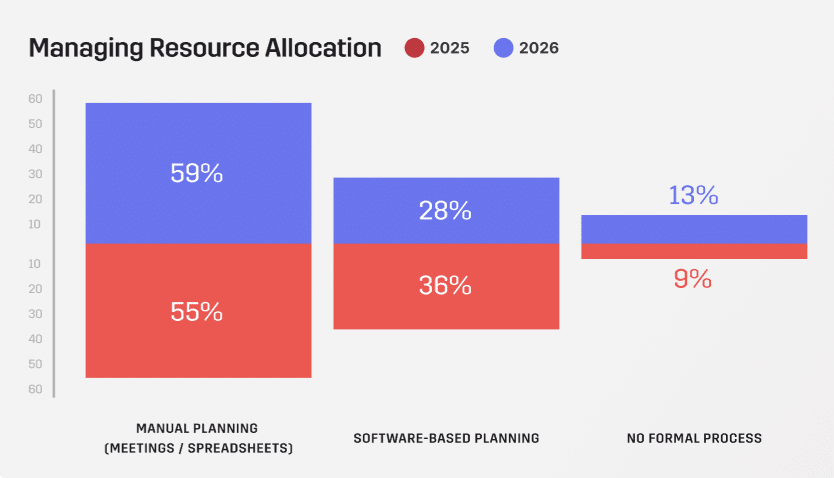
Despite broader software adoption across other categories, 59% of engineering firms still manage resource allocation through manual planning, including spreadsheets and informal meetings. A further 13% have no formal process at all for managing resource allocation.
That figure has also grown since 2025, when it sat at 55%. In the same period, software-based planning has declined from 36% to 28%.
For firms running multiple concurrent projects, this creates a compounding risk that’s difficult to detect until the damage is already done. Capacity conflicts go unnoticed, senior engineers absorb overload and junior staff sit underutilised. And the downstream effects on project quality, staff wellbeing, and budget performance accumulate quietly.
Profitability Tracking: Better, But Still Patchy
Project profitability tracking has improved slightly across the engineering industry, but more than a third of firms are still either not using any form of software to track profitability in real time, or not tracking it at all.
The proportion of firms not tracking profitability in real time has fallen from 21% in 2025 to 13% in 2026. However, spreadsheet use and project manager judgement have both increased as tracking methods, while the use of custom dashboards and other software has declined.
Firms are consolidating around two ends of the spectrum: dedicated project management software on one side, and informal methods on the other. The firms with the clearest financial visibility are those where tracking is embedded in the same platform where project work happens, not sitting in a separate system updated weekly.
When profitability data is live and connected to resourcing decisions, firms can catch cost overruns before they materialise. When it’s lagging, the window for early intervention becomes very narrow.
How Does Your Firm Compare?
The 2026 Engineering Industry Benchmark Report draws on responses from engineering practices across the globe to give the sector a clear picture of how firms are operating right now, covering opportunities and challenges spanning everything from profitability, staffing, technology and growth.
For more insights, and to discover how your margins, utilisation and business development efforts compare to firms like yours, download the report here to see the full picture.
About Total Synergy (Australia)
Total Synergy is an Australian software company based in North Sydney, NSW, helping architecture and engineering practices across Australia improve project visibility, resourcing, and profitability with project management and practice management software. Try Total Synergy for free today and discover how the platform can transform your firm.