
Every hour your team spends on design work, site visits, or client meetings represents revenue for your firm. Many architecture and engineering practices lose thousands of dollars annually because those hours never make it onto a timesheet or get billed incorrectly. When staff forget to log time, estimate hours after the fact, or record work against the wrong project phase, the financial impact compounds quickly.
Accurate time capture directly determines whether projects remain profitable or slide into the red. The firms that master time tracking gain clear visibility into resource allocation, improve billing accuracy, and make data-driven decisions about which projects to pursue.
Common Time Tracking Challenges A&E Firms Face
Architecture and engineering firms face unique obstacles when implementing effective time tracking systems. The creative nature of design work means staff often move between multiple projects throughout a single day, switching contexts from concept development to technical documentation to client consultation. This constant project-hopping makes it difficult to remember exactly how much time was spent on each task, leading to guesswork and inaccurate records.
Manual timesheet entry creates another significant barrier. When teams rely on spreadsheets or paper forms, staff have to remember their activities from days or weeks earlier, leading to estimates rather than precise records. This delay introduces errors that directly affect billing accuracy and project profitability analysis. The administrative burden just compounds, pulling valuable time away from billable work.
Where work happens and where time gets recorded isn’t always the same place. Architects conducting site visits can’t easily access desktop systems. Engineers working from home need different tools than those in the office. That means time either goes unrecorded or gets logged in disconnected systems that don’t integrate with project management and billing platforms.
Project complexity adds another layer of difficulty. A single architectural project might include dozens of phases, from initial concept sketches to construction administration. Recording time against the correct project stage and task requires detailed knowledge of project structures. When staff don’t have clarity about where to allocate their hours, time records lose their analytical value.
Many firms also struggle with the balance between billable and non-billable work. Business development, internal meetings, professional development, and administrative tasks all consume staff time but don’t directly generate revenue. Without proper categorisation, practices can’t accurately calculate utilisation rates or identify where productivity improvements might be possible.
There’s also the challenge of workplace culture. Design professionals are focused on creating designs, rather than managing financial administration. When time tracking software for architects and engineers feels cumbersome or disconnected from daily workflows, adoption suffers. Staff find workarounds, submit incomplete records, or wait until the last possible moment to enter time in bulk, defeating the purpose of systematic tracking.
How Time Tracking Software Transforms A&E Profitability
Implementing dedicated time tracking software for architects and time tracking software for engineers fundamentally changes how practices manage their most valuable resource. Real-time capture eliminates the guesswork and memory gaps that plague manual systems. When staff can record time as work happens (whether through desktop applications, mobile devices, or integrated timers) accuracy improves dramatically. This precision creates reliable data for billing, project analysis, and resource planning decisions.
Accurate time records ensure every billable hour gets captured and invoiced. According to the 2025 Architecture & Engineering Industry Benchmark Report, 41% of firms don’t track realisation or aren’t sure how much time is actually billed and paid. Firms using systematic architecture time tracking recover substantially more of their time investment compared to those relying on estimates or delayed entry.
Project profitability analysis gains new depth when time tracking integrates with project budgets and financial systems. Firms can compare actual hours against estimates at the task, phase, and project level. Enhanced visibility reveals which types of projects consistently exceed budgets, which team members work most efficiently on specific tasks, and where scope creep occurs. Armed with this intelligence, principals make better decisions about future project bids, staffing assignments, and client negotiations.
Resource allocation becomes strategic rather than reactive when firms have clear visibility into how staff spend their time. Engineering time tracking data shows who has capacity for new work, who might be approaching burnout, and where skill gaps exist. Project managers can balance workloads more effectively, ensuring senior staff focus on high-value activities while appropriately leveraging junior team members.
The data generated through systematic time tracking enables benchmarking against industry standards and internal performance metrics. Practices can identify their utilisation rates, compare them to industry averages, and set realistic targets for improvement.
Cash flow improves when accurate time records enable timely, precise invoicing. Rather than waiting to compile time data at month-end, firms can generate invoices as project phases are complete. Clients receive detailed breakdowns of work performed, reducing payment disputes and delays.
Perhaps most significantly, comprehensive engineering time tracking and architecture time tracking create accountability throughout the organisation. When everyone records their time consistently, it becomes easier to have productive conversations about workload, efficiency, and capacity. Staff gain visibility into their own productivity patterns, helping them identify where time gets lost to interruptions or inefficient processes.
6 Essential Features of Architecture Time Tracking Software
1. Easy-to-Use Interface
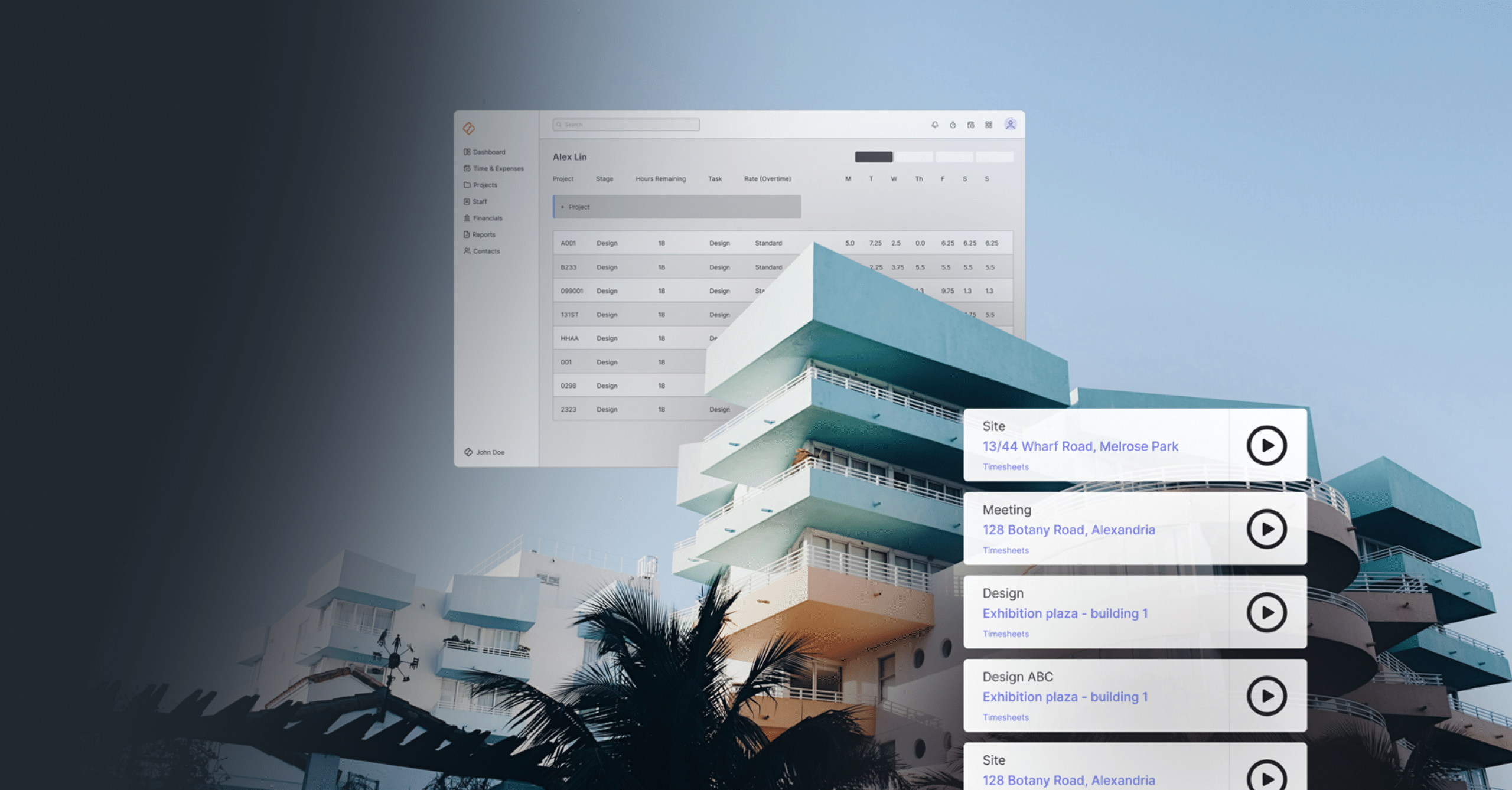
The most powerful time tracking system fails if staff won’t use it consistently. Architecture and engineering professionals need interfaces that feel intuitive and require minimal training. The best time tracking software provides straightforward navigation that allows team members to log time in seconds, not minutes. Simple dropdown menus for project selection, clear task hierarchies that match how projects actually get organised, and prominent save functions all contribute to adoption rates. When the interface respects users’ time and cognitive load, time entry becomes a quick habit rather than a dreaded chore.
2. Interactive Gantt Charts
Visual project planning tools bring project schedules and time tracking together. Gantt charts provide project managers with a comprehensive view of timelines, resources, and deliverables in a single interface. Interactive capabilities allow teams to adjust schedules with drag-and-drop functionality, immediately seeing how changes affect project completion dates and resource allocation. When time tracking connects directly to these visual planning tools, staff can see exactly which tasks need attention and how their work contributes to overall project progress.
3. Project Milestone Tracking
Architecture and engineering projects progress through distinct phases, from schematic design through construction documentation to contract administration. Effective project management software for architects must track these critical milestones and connect them to time tracking workflows. When staff log time, they need clear visibility into which project phase their work supports. Milestone tracking ensures deadlines remain visible and project managers can quickly identify when phases consume more time than budgeted. The connection between milestones and time tracking also improves billing accuracy, as many A&E contracts tie payments to phase completion rather than monthly cycles.
4. Time Entry for Every Task
Granular time tracking capability allows firms to capture work at whatever level of detail matches their project management approach. Staff need the flexibility to record time against broad project categories for straightforward tasks while drilling down into specific activities for complex phases. Whether recording design hours, coordinating meetings, performing technical calculations, or conducting site visits, the system should allow for appropriate specificity. Task-level tracking creates valuable data for estimating future projects, identifying where scope typically expands, and determining which activities consume disproportionate resources.
5. Multiple Device Synchronisation
Modern architectural and engineering work happens wherever professionals need to be: in the office, at job sites, at client meetings, or working remotely. Time tracking software must synchronise seamlessly across desktop computers, tablets, and smartphones. When an engineer starts a timer on their desktop and needs to leave for a site visit, they should be able to stop that timer from their mobile device without losing data. The flexibility ensures time gets captured regardless of location or work context. The mobile capability becomes particularly valuable for field work, where professionals can record time immediately rather than trying to remember hours spent at various sites days later.
6. Easy Workflow Integration
Time tracking cannot exist in isolation from other business systems. The most effective solutions integrate seamlessly with other essential tools, such as project management, accounting, and invoicing platforms. When time records flow automatically into billing systems, administrative burden decreases while accuracy improves. Integration with project budgets allows real-time comparison between planned and actual hours, triggering alerts when projects approach budget thresholds. Connection to accounting software eliminates double-entry, reducing errors and saving administrative time. Staff enter time once, and that information populates invoices, project reports, utilisation calculations, and financial analyses automatically.
Optimise Your A&E Firm’s Time Tracking with Total Synergy
Accurate time tracking shouldn’t consume more time than it saves. With over 25 years of experience in the A&E space, our mission is to simplify how A&E practices manage projects and finances, and our time tracking solution delivers on that promise. We’ve built comprehensive time tracking software for architects and engineers that captures every billable hour while integrating seamlessly with project management and financial systems.
Total Synergy’s platform offers intuitive timesheets, synchronised timers across all devices, and interactive Gantt charts that connect time tracking to project planning. When teams can record time effortlessly against specific tasks and stages while maintaining complete visibility into project budgets and deadlines, profitability follows naturally.
Discover how Total Synergy can transform your practice’s time tracking and project delivery. Book a demo to see the difference comprehensive project management software can make in your A&E firm’s efficiency and profitability.