


Matching the right person to the right project shouldn’t require a spreadsheet and multiple phone calls. But for many architecture firms, that’s (unfortunately) exactly what resource allocation looks like: a manual process driven by memory, availability guesswork, and whoever shouts loudest for a team member.
Good resource allocation tools give you a clear, real-time view of who is available, who is overloaded, and how your team’s time is being spent across your project portfolio. Here are 5 worth considering.
Why Resource Allocation Matters More Than Firms Realise
Staffing costs are the single largest expense for most architecture practices. How you allocate that resource across projects determines not just delivery outcomes, but project profitability.
Over-allocate a senior architect on a fixed-fee project and you erode the margin. Leave a mid-level team member under-utilised for two weeks and you’re paying for capacity that can’t be recovered. Allocate the wrong skill set to a project phase and you create rework that was never in the budget.
The best resource allocation tools for architecture firms connect availability, skill sets, and project demand in a way that supports better decisions, faster.
Top 5 Resource Allocation Tools For Architecture Firms
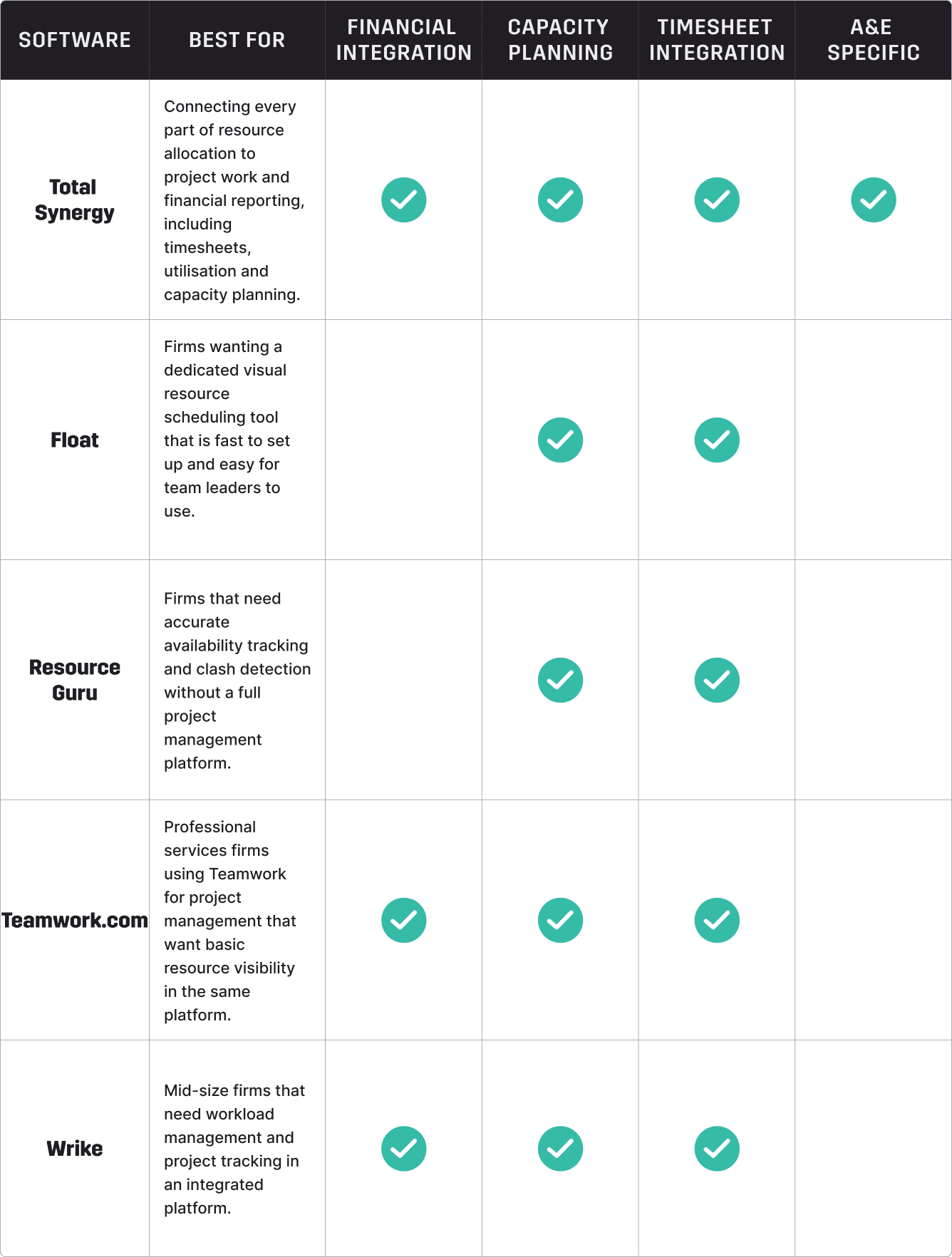
1. Total Synergy
Total Synergy is a practice and project management tool purpose-built for architects and engineers. Resourcing sits inside the same all-in-one platform as project budgets, timesheets, and financial reporting. This is what separates it from standalone resourcing tools: allocation decisions are made with full financial context.
Key features include:
Visual resource scheduling: See your full team’s allocations across projects in a clear, visual format. View by week or month, by individual or team, and across the entire project portfolio.
Availability and capacity management: Total Synergy shows you who has capacity and who is at or over their allocation, before you commit to a new project or take on additional work.
Conflict detection: When a staff member is double-booked or over-allocated, the platform flags it so you can resolve conflicts proactively rather than discovering them mid-delivery.
Budget-connected allocations: Allocations are linked to project budgets and phase hours, so you can see whether a planned allocation fits within the financial parameters of the project before assigning it.
Timesheet reconciliation: Planned allocations are compared to actual time logged, giving managers a clear picture of where estimates were accurate and where future planning needs to be adjusted.
Utilisation dashboards: Monitor billable utilisation rates across the team and by individual. Identify patterns across projects and periods to improve future allocation decisions.
2. Float
Float is one of the most widely adopted dedicated resource scheduling tools for professional services teams. Its visual drag-and-drop interface makes it easy to see who is available, assign work across projects, and adjust allocations as project needs change.
Float operates independently of project financial data: you can see who is allocated, but not whether that allocation is within budget or affecting project profitability.
Best for: Firms wanting a dedicated visual resource scheduling tool that is fast to set up and easy for team leaders to use.
3. Resource Guru
Resource Guru is a resource scheduling platform with a strong availability management interface and clash detection built in. It handles leave, public holidays, and part-time schedules well, giving a realistic picture of true availability.
For architecture firms, Resource Guru is a reliable and straightforward option for managing allocations, but operates as a scheduling layer without connecting to project budgets or financial outcomes.
Best for: Firms that need accurate availability tracking and clash detection without a full project management platform.
4. Teamwork.com
Teamwork includes resource scheduling and workload management features as part of its broader project management platform. Team leaders can view capacity, assign resources to projects, and track utilisation alongside task and project progress.
For architecture firms, Teamwork’s combination of project management and resource scheduling is practical, but its project financial management capabilities are limited compared to platforms purpose-built for architects and engineers.
Best for: Professional services firms using Teamwork for project management that want basic resource visibility in the same platform.
5. Wrike
Wrike includes resource management features covering workload visibility, capacity planning, and time tracking. Its reporting dashboards provide useful team utilisation data.
For architecture firms, Wrike’s resource management is more developed than basic task tools. It is not built for A&E-specific project structures, and its financial management capabilities do not extend to the phase-based budgeting and WIP tracking that practices require.
Best for: Mid-size firms that need workload management and project tracking in an integrated platform.
FAQs
Frequently asked questions about resource allocation for architecture firms
What is resource allocation in architecture firms?
Resource allocation in architecture firms is the process of assigning the right people to the right projects at the right time. In practice, this means deciding which architects, technicians, interior designers, and support staff work on which projects, for how many hours, across which phases of delivery.
Good resource allocation does more than fill up a schedule. It ensures that staff skills match the demands of each project phase, that no one is stretched to breaking point while others have available capacity, and that the hours assigned to each project are within the budgeted fee.
How do architecture firms typically handle resource allocation?
In many architecture practices, resource allocation is managed through a combination of principal judgement, weekly team meetings, and a shared spreadsheet or whiteboard. This approach works well in small studios where a principal knows the workload of every team member. It becomes increasingly fragile as the firm grows and the number of concurrent projects increases.
The most common problems that emerge: over-allocation of high-performing staff who are always the first to be called on, under-utilisation of others whose availability is not clearly visible, and allocation decisions made without checking whether the planned hours fit within the project budget. Purpose-built tools like Total Synergy replace this informal process with a structured, data-driven approach that scales with the firm.
What is the difference between resource allocation and resource planning for architecture firms?
Resource planning is the higher-level, forward-looking view: understanding your firm’s overall capacity, modelling demand across the pipeline, and anticipating where you will need more or fewer people over the coming weeks and months. Resource allocation is the execution layer: actually assigning specific people to specific projects, phases, and tasks.
Both are important for architecture firms. Resource planning informs decisions about whether to take on a new commission, when to start a recruitment process, or whether to bring in a contractor for a busy period. Resource allocation ensures that the day-to-day staffing of your active projects is managed well. The best platforms support both, connecting the strategic capacity view to the operational scheduling layer in a single system.
Why is utilisation tracking important for architecture firms managing resource allocation?
Utilisation rate sits at the intersection of resource allocation and financial performance. When you allocate staff thoughtfully and consistently to billable project work, utilisation rates improve. When allocation is informal or reactive, utilisation tends to be uneven: some staff are consistently over-committed, others are regularly available but not fully deployed.
Tracking utilisation in real time gives principals and studio managers the evidence they need to make better allocation decisions. They can see which team members are at capacity, which have headroom, and how overall utilisation has trended over recent months.
How do you allocate resources effectively across multiple concurrent architecture projects?
The challenge with multiple concurrent projects is that demands shift continuously. A client returns with feedback that pushes a documentation phase earlier than expected. A planning approval delays another project’s start. A team member takes leave during a critical delivery period. Effective allocation in this environment requires both a clear view of current commitments and enough flexibility to adjust quickly when circumstances change.
Practically, this means having a visual schedule that shows all active projects and all team members in one view, with capacity and over-allocation flagged clearly. It means connecting allocations to project budgets so that when you adjust who works on what, you can see the financial impact immediately. And it means having approval or review processes that give principals visibility over allocation decisions before they are locked in.
What role does resource allocation play in managing project profitability for architecture firms?
Resource allocation decisions directly affect project profitability. Allocating a senior architect to tasks that could be handled by a graduate increases the cost of delivery relative to the fee. Allowing a phase to overrun its budgeted hours without flagging it erodes the margin silently.
When allocation is connected to project budget data, as it is in platforms like Total Synergy, project managers can see the financial impact of their allocation decisions in real time. This changes the nature of the decision from a scheduling exercise to a financial one, which is exactly what it should be for a practice trying to protect its margins.
When should an architecture firm invest in dedicated resource allocation software?
The most common trigger is growth: when a practice moves from five to 10 or more people, the informal allocation processes that worked in a small team start to create problems. Staff start to feel over-committed without anyone having a clear view of why. Projects begin to compete for the same people without that competition being visible to leadership. Finance leaders struggle to understand why utilisation is lower than expected.
A second trigger is financial pressure: when project margins are consistently below target and the cause is not immediately obvious, resourcing decisions are often a contributing factor. Purpose-built allocation tools make those patterns visible so they can be addressed directly, rather than remaining embedded in informal processes that are hard to audit or improve.
Getting Resource Allocation Right For Long-Term Benefits
Aside from overbooking, better resource allocation means building a firm where the right work goes to the right people, margins are protected from the start, and leadership can make confident decisions about when to take on new projects and when to pause.
The firms that do this well use tools where resource allocation connects to actual project and financial data, not just a calendar view of availability.
Built in Australia with support teams in Sydney and London, Total Synergy has been serving A&E practices for over 25 years. Book a demo to see how connected resource allocation can work for your firm.