TLDR: Engineering project delivery demands precise scheduling and phase-based budgeting connected to real spend. Total Synergy anchors the financial and resourcing side, Microsoft Project and Primavera P6 offer deep scheduling for complex programmes, Procore suits construction-heavy firms, and Wrike provides lighter workflow coordination.
Engineering projects demand precision at every level, particularly when budgets are broken into dozens of cost categories and teams are spread across disciplines, offices, and external consultants. A missed milestone or a budget overrun can have consequences that ripple across the entire project.
The tools engineering firms use to manage this complexity need to do more than track tasks. They need to connect project delivery to financial performance, give project managers real-time visibility, and support the kind of structured, phase-based project management that engineering contracts typically require.
Here are five tech tools that engineering firms use to manage their projects effectively.
What Engineering Firms Need From Project Management Tools
Engineering project management has specific requirements that separate it from general project management:
- Detailed schedule management with task dependencies and milestone tracking
- Phase and cost-code-based budgeting connected to timesheets and actual spend
- Resource management across disciplines and project teams
- Subconsultant and contractor cost tracking
- Document management with version control and audit trails
- Compliance and reporting to support regulatory and client requirements
- Integration with accounting platforms for invoicing and financial reporting
Top 5 Tech Tools For Engineering Project Management
1. Total Synergy
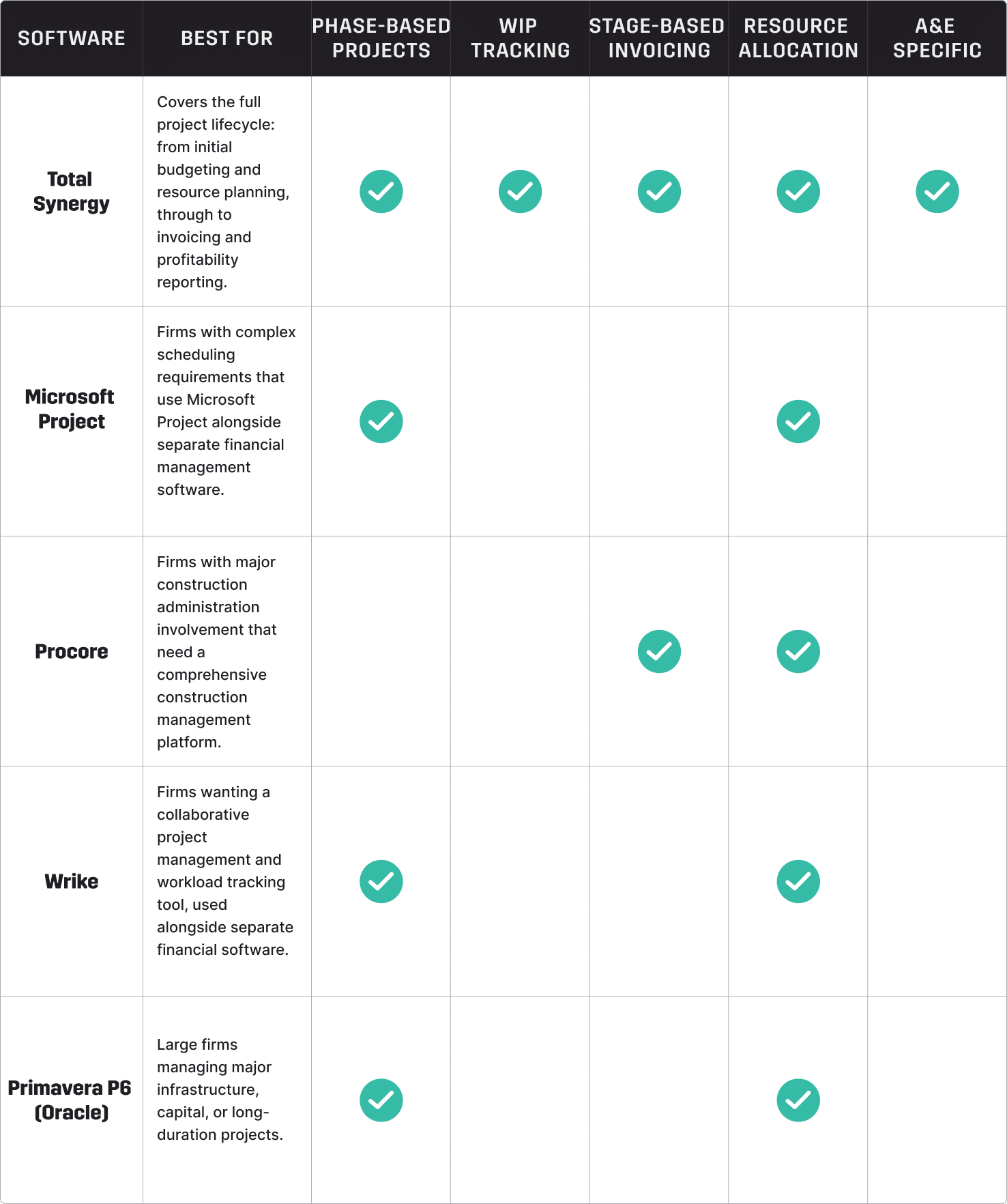
Total Synergy is a project management and financial platform purpose-built for architecture and engineering firms. It covers the full project lifecycle from initial budgeting and resource planning through to project delivery, invoicing, and profitability reporting.
What it does well for engineering firms:
Phase and fee structure management: Structure projects around engineering delivery phases, with budgets, timesheets, and invoicing aligned to each stage. This reflects how engineering contracts are typically structured and priced.
Real-time budget and cost tracking: As teams log time and expenses, project financials update automatically. Project managers can see budget burn at the phase and task level without waiting for a reconciliation run. Subconsultant and contractor costs are tracked against project budgets alongside internal labour.
Resource planning: Allocate your team across concurrent projects, view capacity by discipline, and identify resourcing conflicts before they affect delivery schedules. Allocations connect directly to project budget data.
Gantt charts and task management: Visualise project timelines, set milestones, and assign tasks to team members. Track progress without relying on manual status updates.
Document management: Manage project documents with version control, transmittals, and project file management. The SynergyPIM add-on extends document control for firms with more complex project information management requirements.
Invoicing: Support for multiple billing methods including time and expense, fixed fee, milestone, and percentage completion. Invoices push directly to Xero, MYOB, or QuickBooks without manual re-entry.
Reporting and analytics: Pre-built dashboards for project financial performance, team utilisation, WIP, and firm-wide profitability. Leadership has live data without manual report assembly.
2. Microsoft Project
Microsoft Project is one of the most established project scheduling tools in the engineering sector. It offers detailed Gantt charts, task dependencies, resource allocation, and critical path analysis, and is widely used by structural, civil, and building services engineering teams.
It isn’t connected to financial management or invoicing, requires dedicated training to use effectively, and functions best as a scheduling tool rather than an all-in-one project management platform.
Best for: Engineering firms with complex scheduling and dependency management requirements that use Microsoft Project alongside separate financial management software.
3. Procore
Procore is a construction management platform with document management, project tracking, financial management, and field data features. It is widely used by contractors and project owners managing construction delivery.
For engineering firms with significant construction administration responsibilities, Procore provides strong document control, RFI management, and site data capabilities, but it’s features extend far beyond typical project needs and its cost reflects that scope.
Best for: Engineering firms with major construction administration involvement that need a comprehensive construction management platform.
4. Wrike
Wrike is a work management platform designed for professional services teams. It covers project tracking, resource management, time tracking, and reporting, with strong workflow automation capabilities.
For engineering firms, Wrike is best used as a project coordination layer alongside a financial management system. Its budgeting tools are limited to its higher-tier plans, and it isn’t built around A&E fee stages or WIP, so it works best as a coordination layer alongside a financial management system.
Best for: Engineering teams wanting a collaborative project management and workload tracking tool, used alongside separate financial software.
5. Primavera P6 (Oracle)
Primavera P6 is an enterprise project portfolio management platform used extensively in large-scale engineering, infrastructure, and capital project environments. It provides detailed scheduling, resource management, risk analysis, and progress reporting for complex, long-duration projects.
Primavera P6 is designed for enterprise-scale projects and organisations, and it comes with implementation complexity and a higher cost.
Best for: Large engineering firms or project owners managing major infrastructure, capital, or long-duration projects that require enterprise-grade scheduling and programme management.
Frequently Asked Questions About Engineering Project Management
What is engineering project management?
Engineering project management is the process of planning and controlling engineering projects from fee proposal through to construction phase services. For consulting engineers working in the built environment, it means coordinating disciplines and sub-consultants against a defined scope, with time and cost tracked against each stage of the fee so you know whether a project is profitable while it’s still running.
What does an engineering project manager do?
An engineering project manager is responsible for getting a project delivered on programme and within its fee. Day to day, that means balancing the team’s workload against deadlines and catching scope changes before they eat into the budget. In smaller firms, the same person often manages the client relationship and signs off invoices too. These engineering project management best practices cover the habits that make the role easier.
What features should engineering project management software have?
Start with phase or cost-code budgeting connected to timesheets, so actual spend updates as your team logs time. From there, prioritise resource planning by discipline and invoicing that pushes straight to your accounting platform. Scheduling features matter too, but a schedule without cost data only tells you half the story about how a project is tracking.
What is the difference between scheduling software and engineering project management software?
Scheduling tools focus on the programme, mapping task dependencies and the critical path for complex projects. Engineering project management software also connects that programme to fees and actual spend, so you can see whether a project is profitable as well as whether it’s on time. Many firms use a dedicated scheduler for large programmes and a purpose-built platform for everything that affects project profitability.
What is the best project management software for engineering firms?
It depends on your firm’s size and the type of work you deliver. For consulting engineering firms in the built environment, the strongest foundation is usually a platform purpose-built for A&E that connects project delivery to project financials. Specialist scheduling or construction tools can sit alongside it when project scope requires them. This guide to engineering project management software explains what to look for.
How can engineering firms reduce scope creep?
Scope creep usually shows up in timesheets before it shows up anywhere else. Tracking hours against stage budgets in real time lets project managers spot unbudgeted work early and raise a variation while the client conversation is still easy to have. It’s a widespread issue, with 1 in 5 firms in the 2026 Engineering Industry Benchmark Report saying scope changes impact project budgets on more than half of their work.
How does resource planning improve engineering project management?
Resource planning lets you see capacity by discipline weeks ahead, so you can rebalance work before deadlines slip or senior engineers become overloaded. It matters more as utilisation climbs.
Why should engineering project management connect to your accounting software?
Without integration, invoices and costs get entered twice, which slows billing and introduces errors. A direct connection to platforms like Xero or MYOB means invoices raised against project stages flow straight into your accounts, so project data and financial records stay in step. It also makes project accounting and WIP reporting far more reliable at month end.
Building a Connected Engineering Project Management Stack
The most effective engineering firms build connected tool stacks where each tool does what it is best at, and project data flows cleanly between them.
For most engineering consultancies, that means a purpose-built project management and financial platform at the centre, handling budgets, timesheets, resource planning, and invoicing, supported by specialist tools for scheduling, document control, and construction management where project scope requires it.
Headquartered in Australia and purpose-built for A&E firms, Total Synergy sits at the centre of the project management ecosystem for engineering firms across structural, mechanical, electrical, fire, façade, hydraulic, and multi-disciplinary disciplines.
Book a demo to see how Total Synergy supports engineering project management.