

Most architecture and engineering firms do not suffer from a lack of data. They suffer from a lack of shared reality.
Leadership, project teams, operations, and finance often look at the same firm and see entirely different truths. None of them are wrong. When those truths do not align, the firm loses its ability to see risk early and act decisively.
This disconnect is what most firms call a visibility problem. It is not. And treating it like one is why more reports rarely solve anything.
Four People. Same Firm. Different Realities.
Ask four people in the same firm how things are going and you will get four confident answers.
A principal sees a healthy pipeline and momentum in the market. A project manager sees delivery pressure and scope stretching quietly. Operations sees resourcing tension and bottlenecks forming. Finance sees margin erosion, usually after it has already happened.
Each perspective is valid. Together, they should form a complete picture.
Instead, they exist in parallel. Disconnected. Delayed. Reconciled far too late.
This is how firms end up surprised by outcomes their own teams could see coming months earlier.
More Reports Do Not Equal More Clarity
Most firms respond to visibility issues by producing more reports. Weekly summaries. Monthly dashboards. End of stage reviews.
The volume increases, but clarity does not.
Reporting explains what already happened. Visibility changes what happens next.
In many firms, reporting becomes a substitute for conversation. Information moves upward, but insight does not move across. The business stays busy. The problems stay predictable.
True visibility surfaces pressure before it becomes damage. It allows teams to adjust direction while options still exist.
Without that, firms become very good at explaining overruns and very poor at preventing them.
Where the Reality Gap Hides
The reality gap rarely announces itself clearly. It shows up in patterns that feel manageable and familiar.
On the delivery side, projects appear under control on paper while pressure builds underneath. Scope expands through small decisions. Time is absorbed informally to protect programmes. By the time someone flags a problem, the project is 80% complete and the options are damage control.
On the commercial side, margins erode quietly. Forecasts are adjusted after the fact. Financial signals arrive late, once the work is done and the corrective window has closed.
Operations sits between the two. Capacity looks workable in theory, while coordination becomes fragile in practice.
Individually, none of these issues feel critical. Together, they hide risk in plain sight.
By the time the problem is undeniable, the business is choosing between trade-offs it should have seen months earlier.
Closing the Reality Gap Starts With Integrated Data
The challenge most firms face is not effort or capability. People are working hard and making reasonable decisions with the information they have.
The problem is that the information is fragmented.
When delivery data lives in one place, financial data in another, and resource planning in a third, the reality gap is structural. It does not matter how many reports you generate. You are still asking people to connect dots across systems that were never designed to talk to each other.
This is why Total Synergy exists. Not to generate more reports, but to create a single source of truth that every part of the business can see and act on.
When project managers log time, operations sees capacity constraints forming in real time. When scope changes, finance sees margin impact immediately. When resourcing shifts, leadership sees delivery risk before it becomes critical.
The data is not scattered. The reality is shared.
This is not about surveillance. It is about alignment. It is about giving teams the ability to spot problems at 40% project completion instead of 80%, when corrective action is still possible and options still exist.
What Shared Reality Looks Like
A firm using Total Synergy does not wait until month-end to discover a project is underwater. They see margin erosion as it happens. They adjust resourcing before delivery pressure breaks the team. They make decisions while they still have choices.
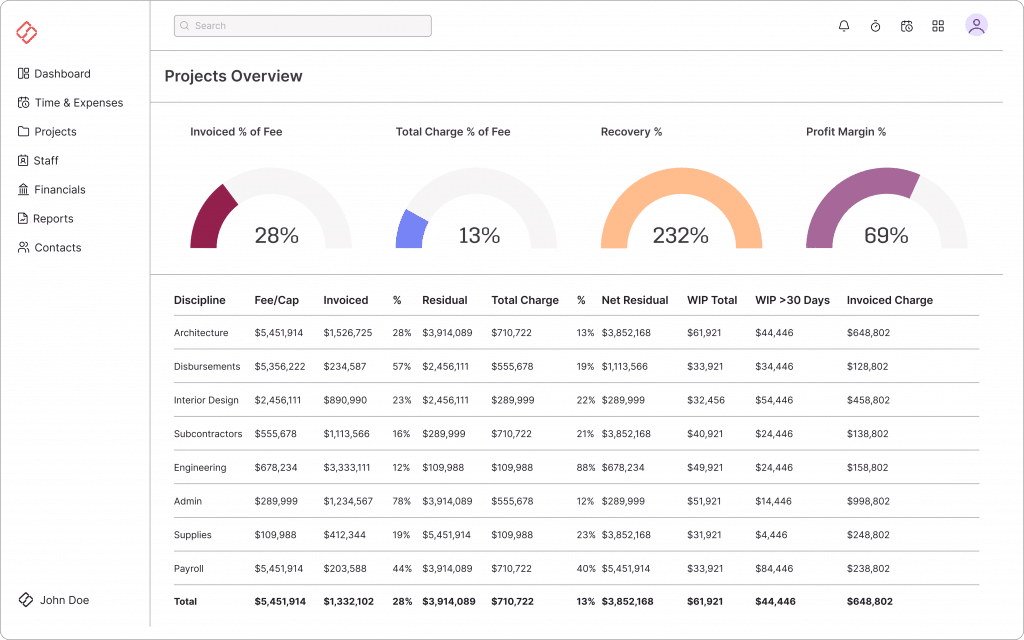
Leadership sees the same data as project teams. Operations and finance are not reconciling conflicting versions of truth weeks after the fact. Everyone is looking at the same business, in real time, with the ability to act early.
When that exists, conversations change. Trade-offs are made earlier and with intent. The firm stops explaining overruns and starts preventing them.
Visibility Is the Foundation.
Most firms know they have a visibility problem. What they often miss is that the problem is not missing information. It is fragmented information creating parallel realities that never reconcile until it is too late.
Closing the reality gap is not about working harder or reporting more often. It is about creating a system where delivery, capacity, and commercial truth exist in one place and inform decisions together.
That is what Total Synergy does. And that is where better decisions begin.

Total Synergy provides project management software for architects and engineers, backed by customers in Australia, New Zealand, and the United Kingdom.