

TLDR: Architecture practices need tools that connect design delivery to project financials, not just task tracking. Total Synergy covers the full lifecycle from budgeting through invoicing, while Asana handles workflow coordination, BIM 360 and Bluebeam manage design and document review, and Aconex suits large multi-stakeholder projects.
Architecture projects are inherently complex. Firms are managing design iterations, client expectations, consultant coordination, regulatory approvals, and delivery timelines, often across multiple projects simultaneously. The tools your practice uses to manage that complexity have a direct impact on both the quality of your output and the health of your finances.
The right architecture project management tools don’t just help teams stay organised. They connect project delivery to project financials, so firms know whether projects are performing, not just progressing.
Here are five tools that architecture practices use to manage their projects effectively.
What Architecture Firms Need From Project Management Tools
Architecture project management comes with specific demands that generic tools can’t always address well.
A good architecture project management tool should support:
- Phase-based project structure that mirrors how architecture contracts are written
- Budget tracking at the project and phase level, connected to timesheets
- Document management with version control for drawings and specifications
- Resource allocation across concurrent projects and disciplines
- Client communication with clear milestone and delivery visibility
- Integration with accounting platforms for invoicing and financial reporting
Top 5 Tech Tools For Architecture Project Management
1. Total Synergy
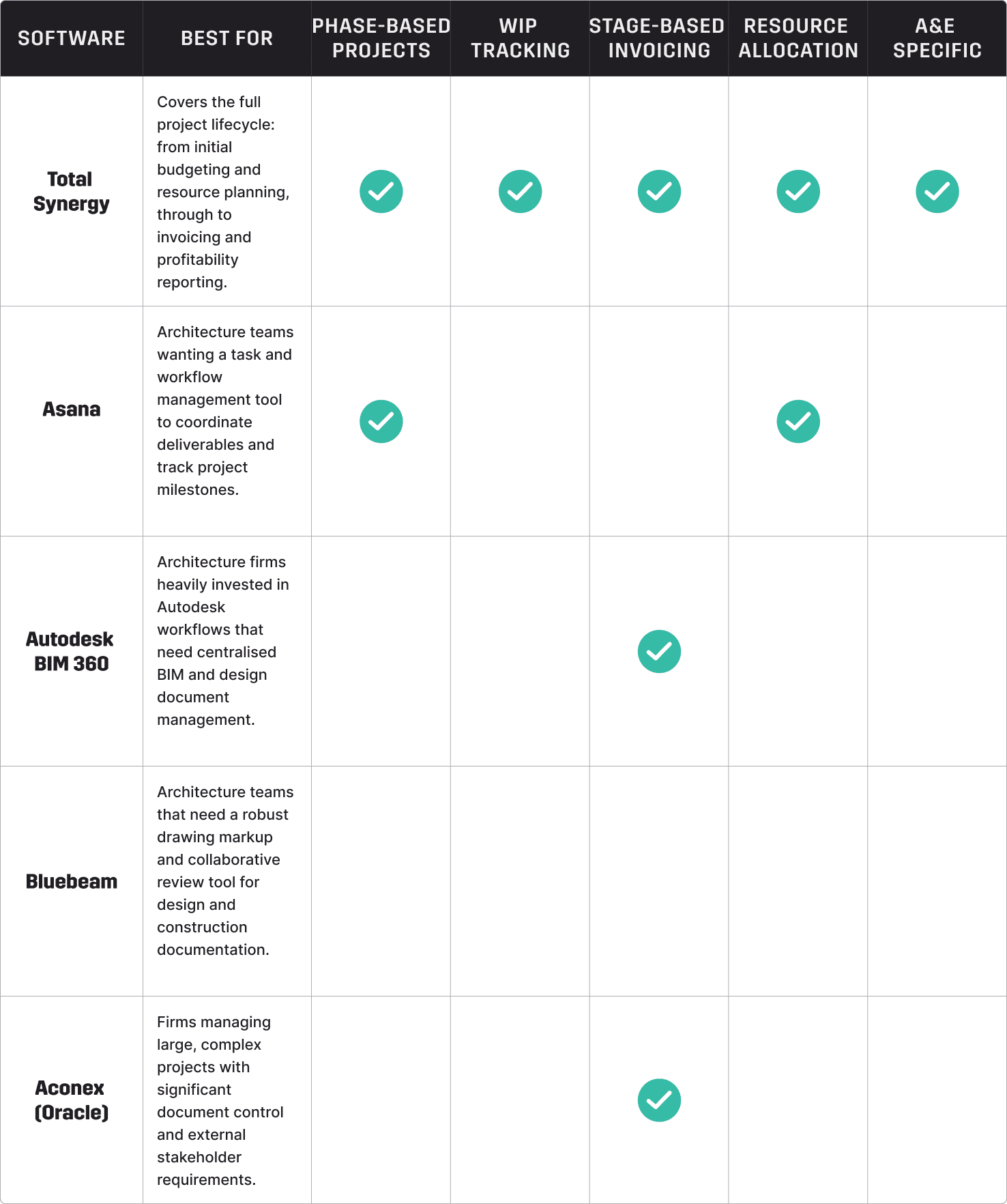
Total Synergy is a project management and financial platform purpose-built for architecture and engineering firms. It covers the full project lifecycle: from initial budgeting and resource planning, through project delivery and timesheet tracking, to invoicing and profitability reporting.
What it does well for architecture practices:
Phase-based project management: Structure projects around the phases of architectural delivery, from concept through to construction administration. Budgets, timesheets, and invoicing align to project phases, not just the overall project.
Real-time budget and financial tracking: As teams log time and expenses, project financials update automatically. Project directors and principals can see budget burn at the phase level without waiting for a monthly report.
Resource allocation: Plan your team’s time across projects, view capacity across the firm, and identify resourcing conflicts before they affect delivery. Allocations connect to project budgets and timesheet data.
Document management and SynergyPIM: Manage project documents with version control and transmittals. Total Synergy’s SynergyPIM add-on extends document control for firms with more complex project information management requirements.
Invoicing: Generate invoices based on milestones, percentage completion, fixed fees, or time and expense. Invoices push directly to Xero, MYOB, or QuickBooks without manual re-entry.
Reporting: Live dashboards for project performance, financial health, team utilisation, and firm-wide profitability. Leadership has the information they need without assembling a report manually.
Integration: Connects with Xero, MYOB, QuickBooks, Microsoft Teams, SharePoint, Salesforce, HubSpot, BambooHR, and more.
2. Asana
Asana is a widely used project and task management platform that helps teams organise work, track progress, and manage deadlines. It offers timeline views, task dependencies, and team collaboration features.
Asana does not track project budgets, manage WIP, or connect to accounting platforms, and is best used alongside a financial management platform rather than as a standalone solution.
Best for: Architecture teams wanting a task and workflow management tool to coordinate deliverables and track project milestones.
3. Autodesk BIM 360
Autodesk BIM 360 is a cloud-based platform for building information modelling, document management, and project collaboration. It connects design data, drawings, and project documentation in a shared environment for teams working across design and construction.
Despite providing strong design data management, clash detection, and document control, the platform is lacking when it comes to project financial management, resource planning, or business reporting.
Best for: Architecture firms heavily invested in Autodesk workflows that need centralised BIM and design document management.
4. Bluebeam
Bluebeam is a PDF-based document review and collaboration tool widely used by architecture and engineering professionals. It enables markup, measurement, and collaborative document review on drawings and specifications, and is a standard tool in many architecture practices.
Bluebeam is a specialist document tool rather than a project management or financial platform. Most firms use it as part of their design workflow alongside a broader project management solution.
Best for: Architecture teams that need a robust drawing markup and collaborative review tool for design and construction documentation.
5. Aconex (Oracle)
Aconex is a project information management platform designed for large-scale projects. It manages document control, correspondence, RFIs, submittals, and workflow approvals across project teams and stakeholders.
For architecture firms working on large or complex projects with multiple external stakeholders, Aconex provides robust document and communication management at scale, but isn’t designed for day-to-day practice management.
Best for: Architecture firms managing large, complex projects with significant document control and external stakeholder coordination requirements.
Frequently Asked Questions About Architecture Project Management
What is architecture project management?
Architecture project management is the process of planning and controlling a design project from the initial brief through to construction administration. It goes beyond keeping deliverables on schedule. Good architecture project management also tracks fees and team time against each stage of the contract, so your practice delivers strong design work without eroding its margin.
What are the main stages of an architecture project?
Stage names vary by contract and region, but most architecture projects move from concept and schematic design through design development, contract documentation, tender and construction administration. Setting each stage up with its own budget and fee lets you see exactly which part of a project is making or losing money, rather than finding out when the whole job closes.
What should architecture project management software include?
At a minimum, it should mirror how your contracts are written, with budgets and timesheets tied to each project stage. Resource planning across concurrent projects and a direct connection to your accounting platform are the next priorities. If a tool can’t show you budget burn by stage, it’s a task tracker rather than an architecture project management system.
What is the best project management software for architecture firms?
The best option depends on where your practice feels the most pain. For most small to mid-sized practices, the biggest gap is financial visibility, so a platform purpose-built for A&E firms that connects project delivery to project financials should sit at the centre of your stack. Specialist design and document tools can then plug in around it.
Can a general task management tool handle architecture project management?
A general task tool can coordinate deliverables and deadlines well, but most aren’t built around stage-based fees or WIP. That leaves your project financials sitting in a separate system or spreadsheet, so you only discover a stage has blown its budget after the fact. Many practices use a task tool alongside a purpose-built financial platform, or move to a single system designed for A&E firms.
How do architecture firms track project budgets in real time?
Real-time budget tracking relies on timesheets and expenses feeding directly into the project budget. As your team logs hours against each stage, spend updates automatically and project leaders can see budget burn as it happens, not at month end.
Why does resource planning matter in architecture project management?
Most practices run several projects at once with the same small team, so one delayed approval or client change can ripple across your whole schedule. Resource planning gives you a forward view of who has capacity and where conflicts are building, weeks before they affect delivery.
Do architecture firms need more than one project management tool?
Most do. BIM platforms and PDF markup tools handle the drawings, while a project management and financial platform tracks the time and money behind them. What matters is that project data flows cleanly between your tools, so your team isn’t re-entering the same information in multiple places and leadership is working from one version of the numbers.
Choosing Tools That Work Together
The most effective architecture practices aren’t relying on a single tool. They have a connected set of tools where each one does what it is best at, and the data flows cleanly between them.
For most architecture firms, that means a purpose-built project management and financial platform at the centre, supported by specialist tools for design, document control, and communication.
Headquartered in Australia and purpose-built for A&E firms, Total Synergy sits at the centre of that stack for thousands of users globally: connecting project delivery to project financials, and giving every team member, from principals to graduates, the information they need to do their job well.
Book a demo to see how Total Synergy works for architecture practices.