
How does your firm compare to the rest of the industry? The 2026 Engineering Industry Benchmark Report reveals key insights about the industry, as well as challenges firms need to stay on top of.

The 2026 Engineering Industry Benchmark Survey drew responses from engineering practices across Australia, the United Kingdom and New Zealand, with Australian firms making up 89% of the cohort.
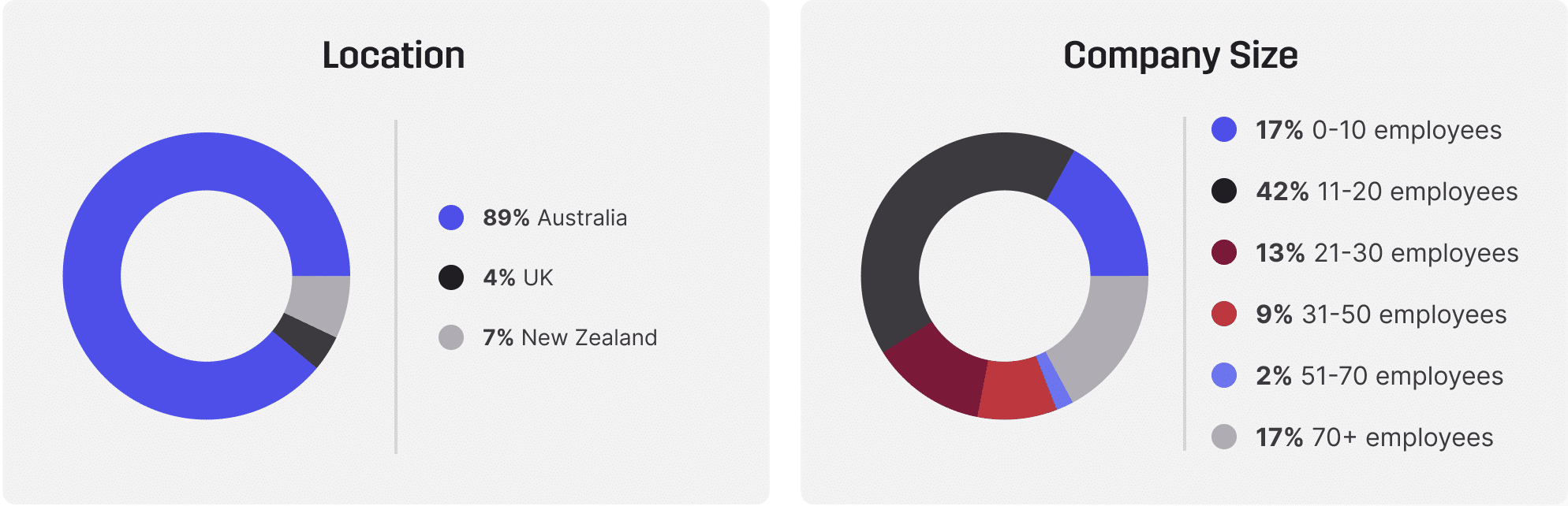
Practices of all sizes participated in the survey, from sole operators through to firms with more than 100 staff. Respondents selected all the disciplines they work across, reflecting the breadth of work within each practice rather than a single primary specialisation.
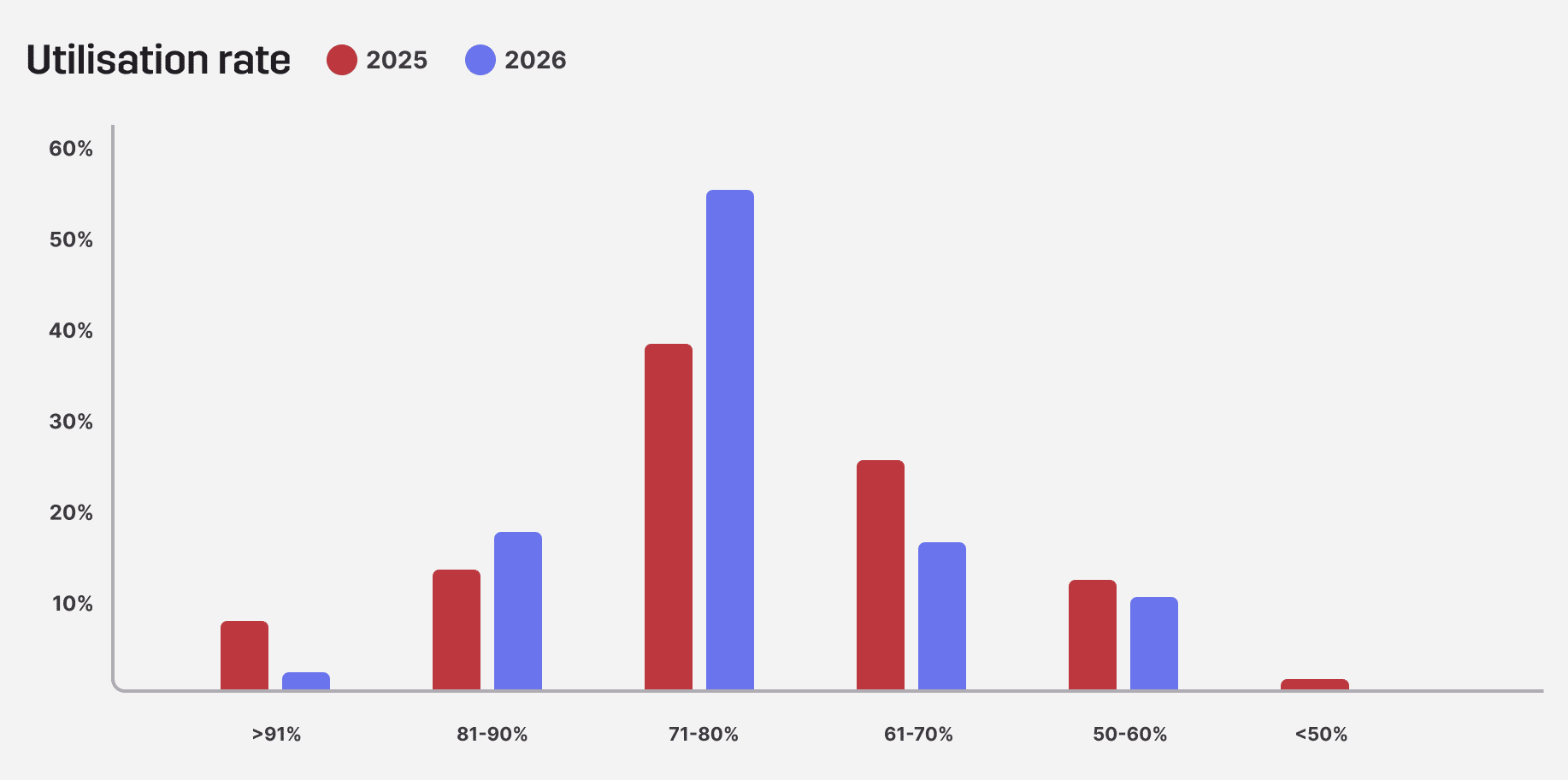
While the majority of engineering firms are operating on short pipelines, utilisation is on the rise.
While shorter pipelines may reflect the nature of project-based work (particularly for smaller firms that win and deliver shorter-duration jobs) it does mean most practices are in a near-constant cycle of business development alongside active project delivery.
At sub-$50k project values, the margin for error is narrow. Even a modest scope extension, delayed payment, or underquoted fee can eliminate profitability on a project entirely.
Technology and AI is a key trend shaping the engineering industry, with many exploring AI and using regularly using platforms or tools.
Software adoption across engineering firms has grown year on year. Financial/invoicing software remains nearly universal, with time tracking, project management and BIM software rounding out the core technology stack for most firms.

Engineering firms are interested in AI as a tool for cutting through administrative burden, improving productivity, and driving business intelligence. Many engineering firms also see opportunities in AI moving forward.
Although profit margins remain healthy at the top end, financial visibility is declining.
Over 50% of firms report net profits over 16%, but the proportion of firms responding “not sure” grew from 11% in 2025 to 22% in 2026. This means that nearly one in four firms does not know their own profit margin.
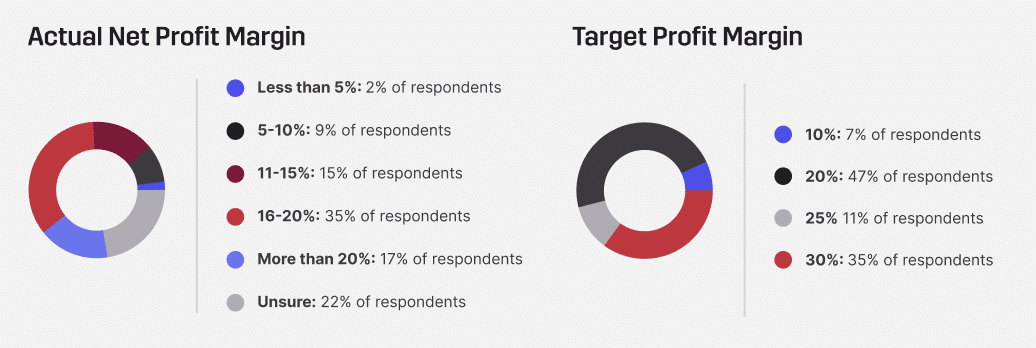
The firms best placed to close the gap between targets and outcome are those that have built visibility into their numbers at every stage of the project lifecycle, not just at the end.
As economic conditions tighten, fewer firms are relying on competitive salaries and professional development as retention strategies.
Yet overall staff turnover has improved, suggesting that the firms holding onto their best people are likely those investing across multiple retention levers, not just one.
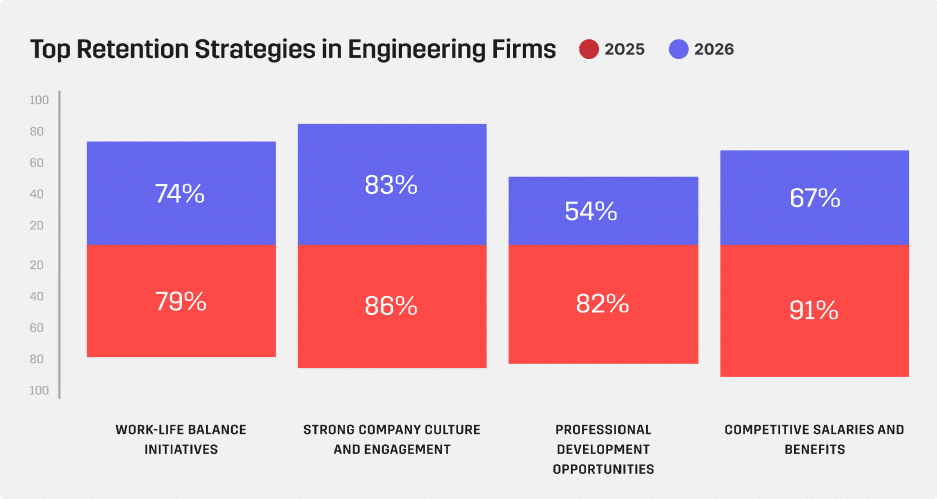
The firms best positioned to weather the next five years of talent pressure will be those that treat workforce management not as an administrative function, but as a strategic one.
Resource management is one of the clearest operational gaps in 2026 across engineering firms.
Concerningly, manual planning has grown. More firms use manual planning, including meetings and spreadsheets, or no formal process at all, to manage resource allocation in 2026, while the use of software for resource management has dropped.
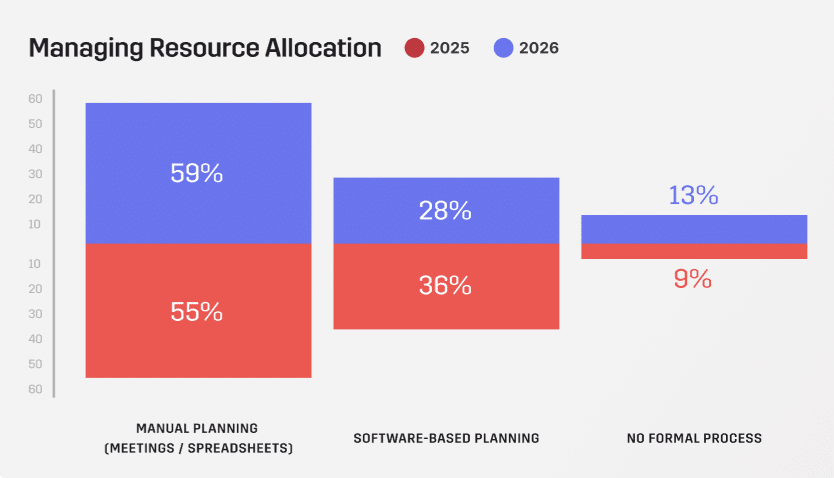
For firms managing multiple ongoing projects, this creates a compounding risk: capacity conflicts go undetected, senior engineers are overloaded without warning, junior staff sit idle, and project quality suffers.
Dedicated project management software gives firms a single place to see how people, budgets, and timelines are tracking across every active project, turning a problem managed by instinct into one that can be managed by data.
In a market where pipelines are shorter and work is harder to win, referrals continue to be the lifeblood of engineering practices, cited by 100% of respondents this year.
For the vast majority of firms, over 50% of their clients are repeat customers, yet few are using a proper system to manage client relationships.

Despite challenges around fee pressure and increasing competition, more than half of firms are looking to grow, whether that be geographically or diversifying into new markets and services.
The challenges engineering firms expect to define the next five years have shifted: for the first time, talent has overtaken economic uncertainty as the engineering industry’s primary long-term concern.
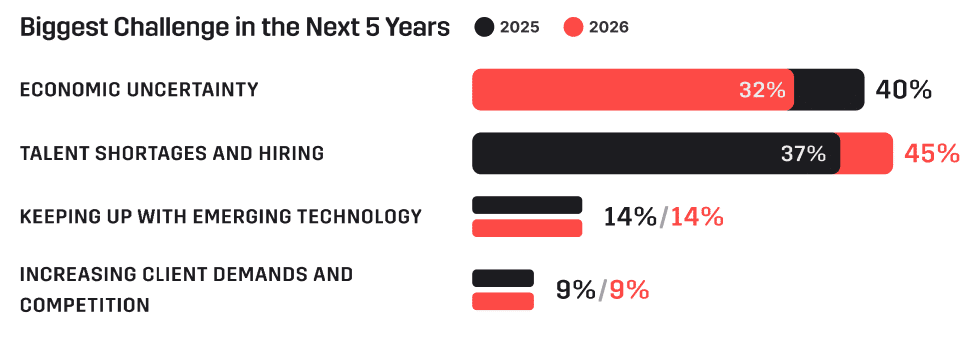
But alongside the challenges, there are clear opportunities, and firms are finding ways to adapt, particularly in AI and infrastructure growth.
The firms most optimistic about the next five years are those actively building the internal capability to move when the market does, and that starts with having accurate, real-time data to act on.