
Efficiency gets talked about constantly in architecture and engineering practices. But it’s rarely defined in a way that leads to action.
In most A&E firms, inefficiency isn’t obvious. It builds quietly. It shows up in project updates that take hours to compile, invoices that go out late, and resource decisions made without reliable data. None of these issues feel critical in isolation. But over time, they reduce margin, limit visibility, and make growth harder to sustain.
Operational efficiency is not about working faster. It is about working with clarity, control, and consistency across every project.
What Is Operational Efficiency?
Operational efficiency in A&E firms refers to the ability to deliver projects profitably while minimising wasted time, administrative effort, and disconnected workflows.
What Does Operational Efficiency Mean in Project-Based Firms?
Operational efficiency in A&E is the ability to deliver projects well, consistently, without burning unnecessary time on internal administration or working around broken systems.
It’s not just about speed. It’s about alignment: the right people on the right projects, with clear visibility into budgets, timelines, and capacity at every stage. It also means reducing the time spent on internal administration, so more effort goes into billable work and project delivery.
For project-based firms, this matters more than in most industries. Revenue is directly tied to hours. When those hours are lost to manual processes, disconnected systems, or rework, profitability is affected even when project demand and pipeline is strong.
How Inefficient Processes Impact Profitability and Growth
Inefficiency creates a compounding problem. When project managers can’t see real-time budget data, they can’t intervene early. When timesheets aren’t submitted on time, invoices are delayed. When resourcing relies on meetings and spreadsheets, the data is already out of date by the time a decision is made.
The 2026 Architecture Industry Benchmark Report highlights this, and found that 39% of firms have at least one in four projects go over budget. Scope creep and poor visibility into project finances are leading contributors.
These aren’t isolated issues. They’re symptoms of limited visibility and disconnected workflows.
What Are Common Bottlenecks in A&E Operations?
Most operational bottlenecks in A&E practices fall into a few recurring categories.
Disconnected systems
When project, finance, and resource data each live in different tools, there’s no single version of the truth. Project managers spend time reconciling information rather than acting on it.
Manual time tracking
Manual timesheet processes create lag in billing accuracy and reporting. When staff submit hours inconsistently, the downstream effect is felt in WIP tracking, invoice timing, and profitability reporting.
Delayed financial visibility
If project performance is only reviewed at month end, opportunities to correct course are missed. Budget overruns that could have been caught in week three become confirmed losses by week six. Real-time finance tracking changes that equation entirely.
Reactive resource planning
Reactive resource planning also costs firms more than they realise. Without forward-looking capacity data, practices either overcommit their best people or leave gaps they don’t spot until delivery is already affected.
How Technology Streamlines Business Operations
The right technology doesn’t replace good judgement. It supports it.
Platforms built for A&E connect data that previously sat in silos. When time tracking, resource allocation, and invoicing all live in one system, project managers can see where a project stands financially, who has capacity, and when action is needed, before the damage is done.
Software built for A&E workflows reduces the administrative burden that pulls teams away from billable work, changing how firms operate. Instead of reacting to problems after they occur, teams can identify risks early and take action before budgets are affected.
What Metrics Measure Operational Efficiency
For A&E firms, operational efficiency shows up across a handful of key metrics.
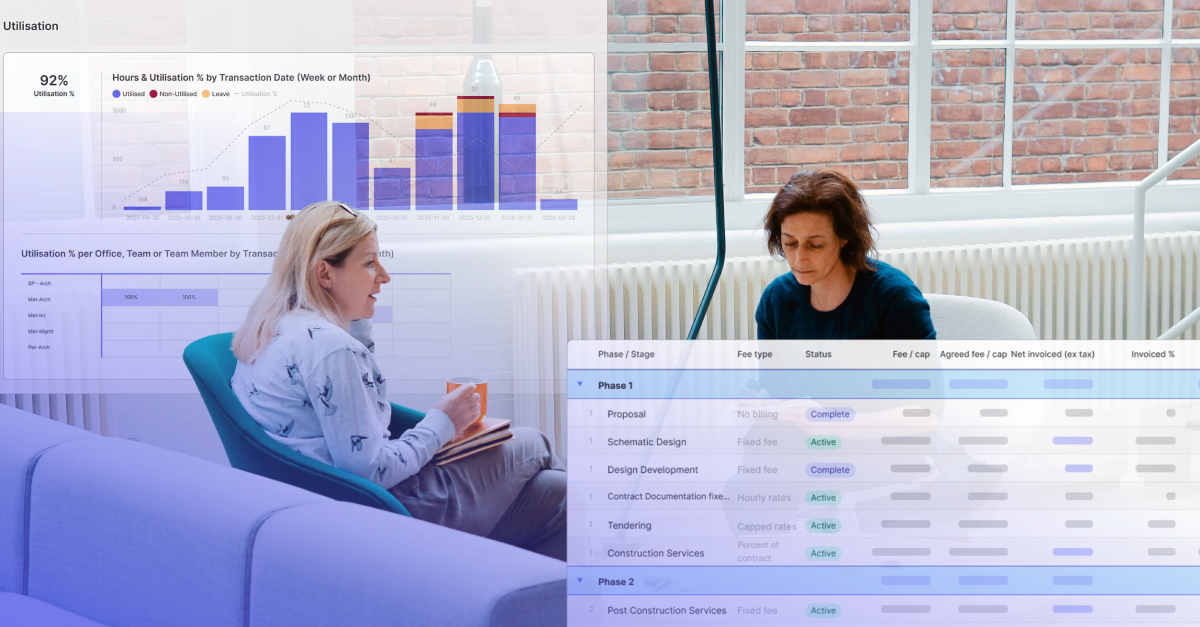
Utilisation rate tracks the proportion of staff time that’s billable. Knowing where your firm sits, and understanding why, is the starting point for improvement.
Realisation rate tracks how much of invoiced revenue is actually collected. 41 per cent of A&E firms don’t track this at all. If it’s not being measured, revenue is almost certainly leaking somewhere.
Days to invoice reflects how quickly your firm converts completed work into cash. Delays here affect cash flow in ways that compound quickly.
WIP at month-end shows how much work has been completed but not yet invoiced. High WIP carryover usually signals invoicing delays or poor visibility into project milestones, and can be one of the clearest signs that something in the billing process needs to change.
Drive Efficiency Gains with Total Synergy
For architecture and engineering firms, improving operational efficiency comes down to visibility and control.
Headquartered in Sydney, Australia, Total Synergy is built for A&E practices that want to move from reactive to proactive. The platform brings project management, project financials, and project analytics into a single source of truth, so your team spends less time chasing information and more time using it.
Real-time dashboards give project managers visibility into budgets, WIP, and capacity without waiting for month-end reports. Integrated invoicing, time tracking, and resource planning mean data flows through the system automatically, rather than being manually reconciled across tools.
To see how Total Synergy gives your practice the financial clarity it needs to deliver better projects, more consistently, book a demo today.